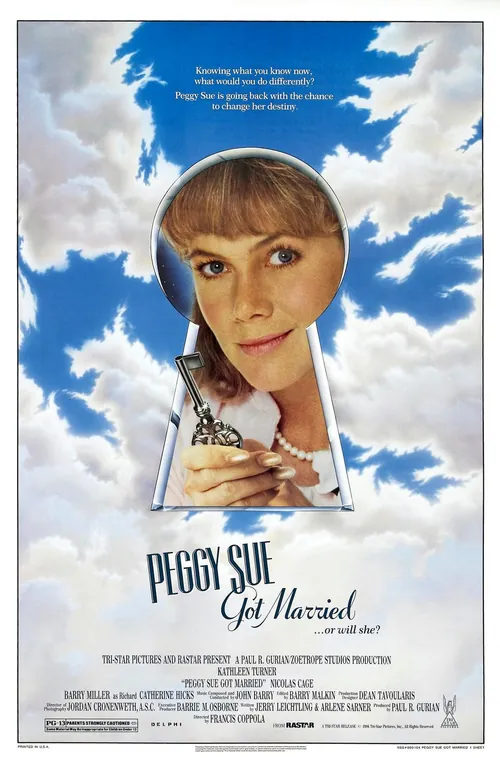
The premise
It's 1985, and Peggy Sue Bodell (Kathleen Turner) has separated from Charlie (Nicolas Cage), the high school sweetheart she married, because he cheated on her. She goes to her 25th high school reunion anyway, with her daughter, Beth (Helen Hunt), and not much enthusiasm. Talking to an old friend, she admits that if she could go back, she'd make different choices. Then her class crowns her reunion queen, and she faints on stage.
She comes to in 1960, at a blood drive at Buchanan High, in her senior year. Her friends put her strange behavior down to blood loss, but the truth is odder: her adult mind is now sitting inside her teenage body. Her parents, Evelyn (Barbara Harris) and Jack (Don Murray), are young again, her little sister, Nancy (Sofia Coppola), still lives at home, and her friends Maddy (Joan Allen) and Carol (Catherine Hicks) are teenagers. Teenage Charlie is waiting for her too, and unlike him, she knows how their marriage will turn out.
How it handles time
There's no machine here, no portal, and no scientist with a formula. Peggy Sue passes out in one decade and wakes up in another, and the film never offers a scientific explanation for the switch. The AFI Catalog's synopsis says she knows she's "trapped in a time warp," which is about as technical as the movie gets. Nothing physical travels. Only her mind goes back, into a body that's already there waiting for it.
The one firm rule is visual, and Coppola never breaks it. Turner is never made to look younger: she plays her 1960 self at her real age, and everyone around her treats her as a kid. Roger Ebert described the convention at the time: "the heroine looks adult to us, but like a teenager to the other characters." On paper it sounds like a shortcut. On screen it's the best decision in the film, because you never lose sight of the adult doing the reliving, and every family dinner plays as both a scene and a memory of one.
Peggy Sue does try to get home the sensible way first. She confides in Richard Norvik (Barry Miller), the class science whiz, hoping his grasp of physics can send her back to 1985, and she convinces him she's telling the truth by describing technology that doesn't exist yet. Later she tries a far less scientific route, which I'll leave for the spoiler section. Neither attempt comes with rules you could write down, and the script doesn't pretend otherwise.
The film's real interest is the question that sits under most time-travel stories: would you choose differently if you knew how everything turned out? Peggy Sue knows Charlie will cheat. She has to decide whether to live that year again the same way or steer it somewhere new, and the pull between those two options is the whole plot. Ebert, reviewing it on release, called the film a "mirror image" of Back to the Future (1985). In that film the hero goes back to meet his parents as teenagers. Here Peggy Sue has to be the teenager at her parents' table.
What works
Turner carries the film, and the awards people noticed. She was nominated for the Best Actress Oscar and a Golden Globe, and the National Board of Review named her Best Actress of 1986. Ebert wrote that her work "must be seen to be believed." What I like most is how little she plays up the gimmick. At home she's openly grateful to her mother and makes an effort with her younger sister, but she stays cool toward her father, and each of those shifts reads as a 40-something woman's second thoughts rather than a teenager's mood swings.
The supporting cast is fun to spot now. Joan Allen and Catherine Hicks play her friends, Jim Carrey turns up as Walter Getz, and Helen Hunt plays her grown daughter. Sofia Coppola, the director's daughter, is her sister. Maureen O'Sullivan and Leon Ames are her grandparents, and John Carradine appears as Leo.
The 1960 on screen looks like a memory someone has polished for 25 years. Jordan Cronenweth's cinematography and Theadora Van Runkle's costumes were both nominated for Oscars, and Dean Tavoularis designed the production. Richard Kelly later showed his crew clips from the film as a reference for the night scenes in Donnie Darko (2001); what he wanted, according to a BFI Education text, was its "burnished nostalgia." The film was shot in Sonoma County, California, with Santa Rosa High School standing in for Buchanan High.
The music does a lot of the time traveling for you. Buddy Holly's 1959 song "Peggy Sue Got Married," which gave the film its title and its heroine her name, plays over the opening credits. John Barry wrote the score, and the soundtrack drops in period songs such as "Tequila" by The Champs and "Teenager in Love" by Dion & the Belmonts.
What doesn't
Nicolas Cage is the problem, and by his own account it was a choice. He has said he turned the part down five or six times and only agreed if he could play Charlie in an over-the-top way, and he based the character's nasal voice on Pokey from The Gumby Show. Turner is playing real regret opposite him, and he's playing a cartoon. The film's central question, whether she should marry this man again, gets harder to take seriously when he's doing that voice. Rita Kempley called it an "icky performance" in The Washington Post. I wouldn't go that far, but I never understood what either version of Peggy Sue saw in him.
Kempley also complained about a "pokey opening," and I agree with her there. The 1985 reunion takes its time getting Peggy Sue onto that stage, and the setup feels long for a film that runs 103 minutes.
The nostalgia is softer than it needs to be, too. Rotten Tomatoes' consensus files the film among "'80s boomer nostalgia films" before making the case for Turner, and that's fair: 1960 here is lovely to look at, and the script rarely questions why she might want to go back to it. Anyone expecting a caper in the style of Back to the Future should adjust, because this is a slower, sadder film about adult regret. Tri-Star noticed the same thing: it revised its plan to sell the movie as a follow-up to that film after finding that teenagers liked it less than it had hoped.
Final score
Overall: 7/10. Good, with clear weaknesses: one of the best lead performances in any time-travel film, opposite a love interest the movie never makes worth the trip.
Paradox Meter: 2/5. There's no mechanism to test beyond a fainting spell and a casting convention, and the one piece of hard evidence the film offers raises questions it chooses not to answer.
If you liked this
Back to the Future
Donnie Darko
Quantum Leap
- Frequency (2000): another time-travel story where a second chance at the past is the whole point. (not on the site yet)
Frequently asked questions
Is Peggy Sue Got Married a time-travel movie?
Yes. Peggy Sue Bodell (Kathleen Turner) faints at her 25th high school reunion in 1985 and wakes up in 1960, in her senior year, with her adult mind inside her teenage body. The AFI Catalog lists time travel among the film's major subjects.
How does time travel work in Peggy Sue Got Married?
Loosely. There's no machine, no portal, and no scientific explanation: she passes out in one decade and wakes up in another, and only her mind travels. The one firm rule is visual: Turner is never made to look younger, so the audience sees an adult while everyone in 1960 sees a teenager. Paradox Meter: 2/5, "Loose."
Is Peggy Sue Got Married a good movie?
Yes, with clear weaknesses: it gets a 7/10 here, mostly for Kathleen Turner, whose performance earned Best Actress nominations at the Oscars and the Golden Globes. Nicolas Cage's cartoonish Charlie and a slow 1985 opening keep the score from going higher.
How is Peggy Sue Got Married different from Back to the Future?
Roger Ebert called it "not a clone, but a mirror image" of Back to the Future (1985): that film's hero goes back to meet his parents as teenagers, while Peggy Sue goes back into her own teenage body. According to the AFI Catalog, Tri-Star revised its plan to sell it as a follow-up when teens liked it less than hoped.
Why does Nicolas Cage talk like that in Peggy Sue Got Married?
By choice. According to Wikipedia, Cage has said he turned the role down several times, agreed only if he could play Charlie over the top, and based the nasal voice on Pokey from The Gumby Show.
Where was Peggy Sue Got Married filmed?
In Petaluma and Santa Rosa, in Sonoma County, California, from August to October 1985, according to the AFI Catalog. Santa Rosa High School stood in for Buchanan High.
⚠ Spoilers: the timeline explainedShow spoilersHide spoilers
Peggy Sue spends 1960 trying out other lives. She breaks up with Charlie (in AFI's version, she agrees they should see other people), and when he turns her down after a party, reminding her of her promise to wait until marriage, she ends up at an all-night café with Michael Fitzsimmons (Kevin J. O'Connor), an artsy loner who talks Hemingway and Kerouac. They ride off on his motorcycle and spend the night under the stars. Michael later asks her to join him in Utah in a polygamous arrangement. She says no and tells him to write about their night instead. Richard proposes as well, and she turns him down.
The less scientific escape route belongs to her grandparents. She tells them the whole story, and on her 18th birthday her grandfather takes her to his Masonic lodge, where the members perform a ritual to send her back to 1985. The lights go out mid-ritual, and Charlie, who followed her, carries her off. The lodge members believe it worked. In a greenhouse, Charlie tells her he's giving up music to take a share of his father's business, proposes, and gives her a birthday locket holding baby pictures of the two of them, which look like the children they'll have. It echoes the antique locket she wore to the reunion, with the baby pictures she took to be her kids. Realizing that leaving Charlie would mean losing her children, she stays with him that night, on the very birthday when, as she explained earlier, she got pregnant the first time around.
She wakes in a 1985 hospital with Charlie at her bedside. He shows her a book by Michael Fitzsimmons, dedicated "To Peggy Sue and a starry night." Charlie says he regrets cheating and wants her back, and she remembers her grandfather crediting her grandma's strudel with keeping the family together. She invites Charlie to dinner: "I'll make a strudel."
The ritual doesn't send her home. The return comes after she chooses Charlie, so the only rule the film has is an emotional one. The dedication is the film's main hard clue. Wikipedia reads it as a sign she "possibly did travel back in time," while the AFI Catalog says she realizes her trip "changed the events of her past." If the book exists, 1960 really happened and something changed, but the film never says what else came out different, and a fainting spell followed by a hospital bed leaves the dream reading wide open. That refusal to commit is why the Paradox Meter stays at 2.
One production footnote: according to the AFI Catalog, Coppola persuaded Tri-Star to pay for a reshoot of the ending after test screenings, because the first version lacked the emotional impact he wanted.
Spoiler questions
How does Peggy Sue Got Married end?
She wakes up in a 1985 hospital with Charlie at her bedside, and he says he regrets cheating and wants her back. The Masonic lodge ritual meant to send her home isn't what does it: she returns only after choosing to stay with Charlie in 1960.
Who does Peggy Sue end up with?
Charlie. In 1960 she turns down Michael Fitzsimmons's offer to join him in Utah and Richard Norvik's proposal, then stays with Charlie once she realizes that leaving him would mean losing her children. Back in 1985, she invites him home for dinner: "I'll make a strudel."
Did Peggy Sue really go back in time, or was it a dream?
The film doesn't settle it. Michael Fitzsimmons's book, dedicated "To Peggy Sue and a starry night," is the main clue: Wikipedia reads it as a sign she "possibly did travel back in time," and the AFI Catalog says her trip "changed the events of her past." Waking up in a hospital bed still leaves the dream reading open.
Sources
Catalogue entry
Research dossier behind this review (19 sources)
- Wikipedia, "Peggy Sue Got Married" (retrieved 29 Sep 2026)
- AFI Catalog of Feature Films, "Peggy Sue Got Married (1986)" (retrieved 29 Sep 2026)
- Box Office Mojo, "Peggy Sue Got Married (1986)" (retrieved 29 Sep 2026)
- The Numbers, "Peggy Sue Got Married (1986) – Box Office and Financial Information" (retrieved 29 Sep 2026)
- Roger Ebert, "Peggy Sue Got Married", Chicago Sun-Times / RogerEbert.com, 8 Oct 1986 (retrieved 29 Sep 2026)
- Rotten Tomatoes, "Peggy Sue Got Married" (retrieved 29 Sep 2026)
- Wikipedia, "Donnie Darko", Design section (retrieved 29 Sep 2026)
- Wikipedia, "59th Academy Awards" (retrieved 29 Sep 2026)
- Golden Globes awards database, "Peggy Sue Got Married" (retrieved 29 Sep 2026)
- National Board of Review, 1986 award winners (retrieved 29 Sep 2026)
- Metacritic, "Peggy Sue Got Married" (retrieved 29 Sep 2026)
- JustWatch US, "Peggy Sue Got Married" (retrieved 3 Oct 2026; first retrieved 29 Sep 2026)
- JustWatch UK, "Peggy Sue Got Married" (retrieved 3 Oct 2026; first retrieved 29 Sep 2026)
- Wikipedia, "17 Again (film)" (retrieved 29 Sep 2026)
- Wikipedia, "The Family Man" (retrieved 29 Sep 2026)
- Wikipedia, "Frequency (2000 film)" (retrieved 29 Sep 2026)
- Wikipedia, "Totally Killer" (retrieved 29 Sep 2026)
- JustWatch Italy, "Peggy Sue si è sposata" (retrieved 3 Oct 2026; first retrieved 29 Sep 2026)
- LEFFEST – Lisboa Film Festival 2026, "Peggy Sue got Married" (retrieved 29 Sep 2026)
Poster and trailer
- Official poster: The Movie Database (TMDB)
Review by Loop & Branch Editorial. Published . Scores explained in How we review.