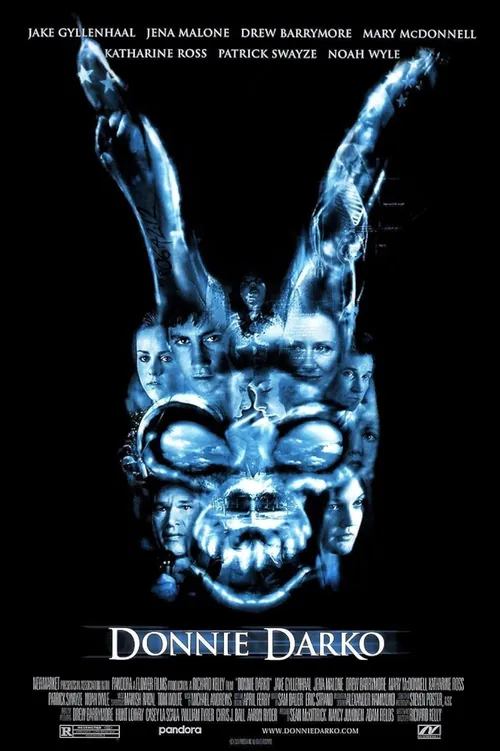
Trailer
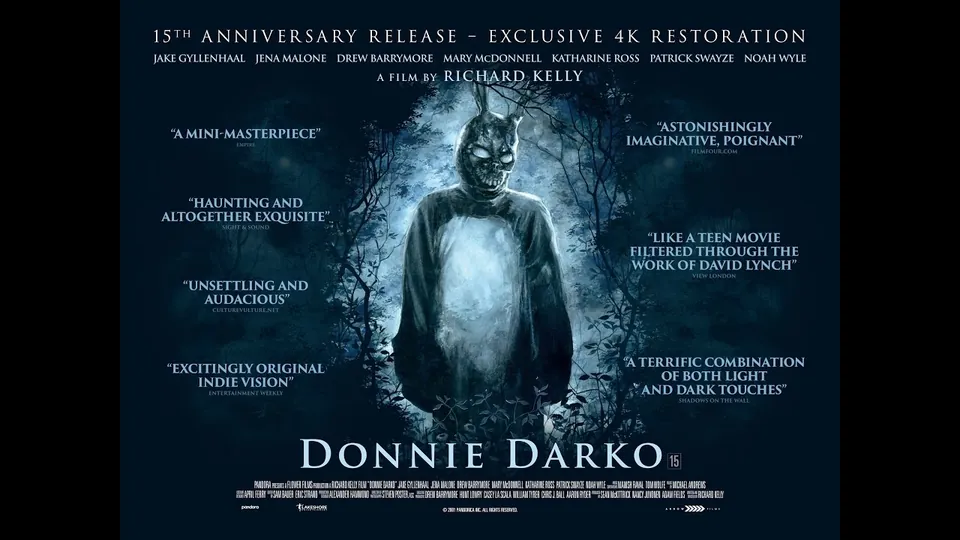
The premise
It's October 2, 1988, in a Virginia suburb. Donnie Darko (Jake Gyllenhaal) is a troubled teenager who hears a voice in the night and sleepwalks outside, where he meets Frank, a figure in a monstrous rabbit costume. Frank tells him the world will end in 28 days, 6 hours, 42 minutes, and 12 seconds. Donnie wakes up the next morning on a golf course and comes home to find that a jet engine has crashed into his bedroom. The FAA investigators can't say where it came from.
Frank keeps coming back. Donnie starts seeing a therapist, Dr. Lillian Thurman (Katharine Ross), falls for Gretchen Ross (Jena Malone), the new girl at school, and gets hooked on the idea of time travel. His science teacher, Dr. Kenneth Monnitoff (Noah Wyle), lends him The Philosophy of Time Travel, a book by Roberta Sparrow, a former teacher at the school who now lives as a recluse the local kids call "Grandma Death."
How it handles time
In the theatrical cut, the time travel is mostly a feeling of dread with a clock attached. Title cards count down the days to October 30, 1988 (Christopher Nolan and Emma Thomas suggested them to Kelly when he was revising the film in 2001). Frank asks Donnie whether he believes in time travel. Monnitoff tells him it would take a metal vessel and a wormhole. And Donnie starts seeing liquid "spears" coming out of people's chests, which read as a picture of where each person is about to go. Kelly borrowed that image from John Madden's on-screen telestrator in NFL broadcasts, which is the kind of odd, specific idea the whole film is made of.
The actual rules came later. After shooting, Kelly wrote pages of The Philosophy of Time Travel that lay out a full framework, starting with the Tangent Universe, an unstable copy of our universe that can't last more than a few weeks. Those pages first appeared on the film's official website and the DVD, and only went on screen in the director's cut. Kelly has said he wrote them "as an exercise in interpretation" rather than as canon, and also, on the DVD commentary, that "this film kinda does need Cliffs Notes." You can feel the pull between those two positions every time you rewatch it.
There's a second way to watch it, too. Dr. Thurman calls Donnie's visions "daylight hallucinations," symptoms of paranoid schizophrenia, and Kelly has said he used that diagnosis as "a great way to ground a supernatural story." For most of its running time the film supports both readings, and that's what I like best about it. You can watch a time-travel story or a story about a teenager coming apart, and the scenes work either way.
The director's cut settles the question. It adds 20 minutes, puts the book's pages on screen as text, and swaps the opening song, "The Killing Moon" by Echo & the Bunnymen, for INXS's "Never Tear Us Apart," which Kelly wanted in 2001 but couldn't afford. Roger Ebert liked it more than the original (3 stars out of 4, up from 2.5) and called it "alive, original and exciting." Several later critics went the other way, and Jonathan Dean of Total Film called the on-screen pages "handholding." I'm with Dean. The director's cut is worth seeing once you know the film, but the pages answer questions I'd rather keep asking.
What works
Gyllenhaal holds the film together. Donnie has to be funny and frightening in the same scene, sometimes in the same line, and Gyllenhaal never lets one side swallow the other. The family around him feels lived in, too. Mary McDonnell and Holmes Osborne play his parents, and Maggie Gyllenhaal plays his older sister, Elizabeth, a casting idea that came from Jake himself.
The satire of 1988 suburbia is sharper than people remember. Patrick Swayze plays Jim Cunningham, a motivational speaker whose "attitude lessons" the gym teacher, Kitty Farmer (Beth Grant), brings into the classroom. Drew Barrymore, whose company Flower Films produced the movie, plays Karen Pomeroy, the English teacher. When Kelly met Francis Ford Coppola before the film was made, Coppola singled out one of her lines as "what your whole movie's about."
It looks and sounds like nothing else from its year. Kelly and cinematographer Steven Poster shot on 35 mm in anamorphic widescreen, and for the night scenes Kelly showed the crew clips from Peggy Sue Got Married (1986) for their "burnished nostalgia." The soundtrack is full of '80s songs, from "The Killing Moon" to Duran Duran's "Notorious" at the school talent show. Michael Andrews' score gives the film its sad, quiet center, and so does his cover of "Mad World" with Gary Jules, which later spent three weeks at No. 1 in the UK and became the 2003 Christmas No. 1.
And then there's Frank. The rabbit costume was designed from Kelly's own sketches, and it has stuck around for decades longer than the film's modest box office would suggest: a Frank skin even turned up in Call of Duty: Black Ops Cold War in 2021.
What doesn't
The film asks a lot and gives back very little on a first viewing. The theatrical cut leaves the mechanism almost entirely unexplained, and Kelly had to keep it under two hours, so some threads (a Watership Down lesson in the English class, for one) didn't make it in. Salon's Dan Kois called the chain of events behind the plot "baroque," and that's fair. When you do look up the rules, some of the machinery feels more complicated than it needs to be.
Not every critic bought it, either. Sam Adams called it a "big mess" in City Paper when it came out. I don't agree, but I understand how someone reaches that verdict after a single watch.
Final score
Overall: 9/10. It's one of the great debut films, and its biggest flaw is that it asks more of a first viewing than most people will give it.
Paradox Meter: 3/5. The framework holds together on paper, but the theatrical cut keeps it off screen, and some of its steps only make sense if you don't ask why they were needed.
If you liked this
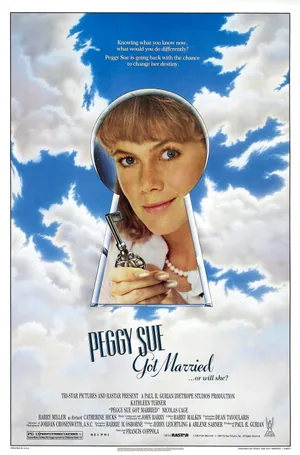
Peggy Sue Got Married
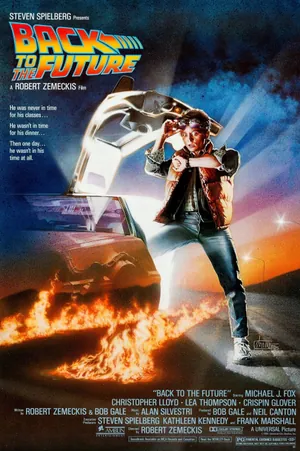
Back to the Future
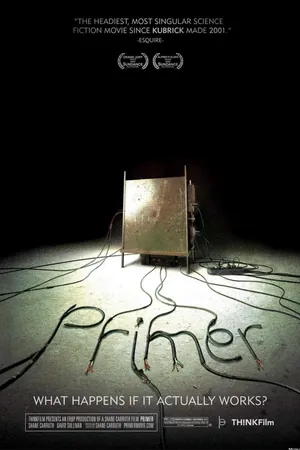
Primer
- S. Darko (2009): the direct-to-video sequel about Samantha Darko, made without Kelly, who said in 2017 that he'd never seen it. (not on the site yet)
- Southland Tales (2006): Kelly's next film, and he says his films are "very connected." (not on the site yet)
⚠ Spoilers: the timeline explainedShow spoilersHide spoilers
The engine that crashes into Donnie's room on October 2 comes from the end of the story. On the final morning, a plane carrying his mother, Rose, and his younger sister, Samantha, home from Los Angeles flies through a vortex that has formed over the Darko house. One of its engines is torn off and sent back in time.
In the terms Kelly wrote for The Philosophy of Time Travel, the 28 days take place in a Tangent Universe that begins around midnight on October 2. The jet engine is the Artifact, a metal object that has to be returned to the Primary Universe before the Tangent Universe collapses and destroys everything. Donnie is the Living Receiver, the one chosen to send it back, and he gets powers (strength, foresight, telekinesis) along with the visions. The people around him are the Manipulated Living, pushed into strange behavior that nudges him along. Those who die inside the Tangent Universe become the Manipulated Dead, and they set up an Ensurance Trap that leaves him no choice.
The trap closes on the night of the Halloween party, in the road outside Roberta Sparrow's house. A car swerves, runs Gretchen over, and kills her. The driver is Frank Anderson, Elizabeth's boyfriend, and he's wearing the rabbit costume from Donnie's visions. Donnie shoots him in the right eye, which is why the Frank of his visions has a hollow, bleeding eye. Frank and Gretchen are the Manipulated Dead. According to Kois, Kelly says on the DVD commentary that Donnie uses telekinesis to tear the engine off his mother's plane.
The 28 days run backwards. Donnie wakes up in bed on October 2, laughs, and stays there, and the engine kills him. Around town, the people whose lives he touched wake from troubled dreams, and Gretchen and Rose wave to each other the next day as if they almost remember something. Kelly said in 2017 that the people who died in the Tangent Universe are "resurrected at the end of the film arguably," and in 2026 he described the 28 days as a "dream" everyone "collectively all experienced together."
Whether Donnie chooses to die is left open. I read his laugh as the moment he understands, and it's the film's best scene. The Paradox Meter score comes from the parts that stay murky even with the book in hand: the manipulating force is never named (Kois paraphrases Kelly's commentary as suggesting it's "basically, God"), and even Kois admits he can't explain why Donnie's mother had to be on that particular plane.
Sources
Catalogue entry
Research dossier behind this review (35 sources)
- Wikipedia, "Donnie Darko" (latest edit 21 Sep 2026; retrieved 29 Sep 2026)
- Wikipedia, "Donnie Darko: The Director's Cut" (retrieved 29 Sep 2026)
- Box Office Mojo, "Donnie Darko (2001)", title summary with all releases (retrieved 29 Sep 2026)
- Rotten Tomatoes, "Donnie Darko" (retrieved 29 Sep 2026)
- Metacritic, "Donnie Darko" (retrieved 29 Sep 2026)
- Metacritic, "Donnie Darko: The Director's Cut" (retrieved 29 Sep 2026)
- Dan Kois, "Everything you were afraid to ask about 'Donnie Darko'", Salon, 23 Jul 2004 (retrieved 29 Sep 2026)
- Fathom Entertainment press release, "Donnie Darko Returns to the Big Screen for Its 25th Anniversary…", 8 Sep 2026
- Fathom Entertainment event page, "Donnie Darko 25th Anniversary" (retrieved 29 Sep 2026)
- Britt Rivera, "Donnie Darko Returns To Theaters To Celebrate Cult Classic's 25th Anniversary", Screen Rant, 8 Sep 2026
- "Fathom, Saga Arts Celebrating Donnie Darko's 25th Anniversary", Digital Cinema Report, 22 Sep 2026
- Jim Vejvoda, "Donnie Darko Returning to Theaters in 4K for 25th Anniversary", IGN, 8 Sep 2026
- Cinemark, "Donnie Darko 25th Anniversary" listing (retrieved 29 Sep 2026)
- Fandango, "Donnie Darko 25th Anniversary (2026)" (retrieved 29 Sep 2026)
- Vivian Thorne, "'Donnie Darko' 4K Re-Release Lands on Donnie Darko Day", iHorror, 13 Sep 2026
- Miles Klee, "Richard Kelly on Donnie Darko at 25: 'It's a Miracle That Any Movie Gets Made'", Wired, 8 Sep 2026
- American Cinematheque, "Donnie Darko", Aero Theatre, Fri 2 Oct 2026, Beyond Fest 2026 (retrieved 29 Sep 2026)
- Jennifer Maas, "'Donnie Darko' Sequel Book Releasing This Year From Filmmaker Richard Kelly; Cover and Teaser Revealed (EXCLUSIVE)", Variety, 25 Aug 2026
- Germain Lussier, "A 'Donnie Darko' Sequel Book With Massive Franchise Aspirations Is Coming", Gizmodo, 25 Aug 2026
- Forthcoming Books, "The Philosophy of Time Travel: The Epic Sequel to the Motion Picture Donnie Darko" (retrieved 29 Sep 2026)
- Amazon.es listing, same title (retrieved 29 Sep 2026)
- Browns Books listing, ISBN 9798993671598 (retrieved 29 Sep 2026)
- Arrow Video US, "Donnie Darko Limited Edition 4K UHD" (retrieved 29 Sep 2026)
- Erik Anderson, "Mutant and Arrow Video Launch Mutant Mediabook 4K Ultra HD Blu-Ray Line…", AwardsWatch, 2 Nov 2025
- Orbit DVD, "Donnie Darko (4K UHD, Limited Edition Mutant Mediabook)" (retrieved 29 Sep 2026)
- Alan Siegel, "It's a Mad World: The 'Donnie Darko' Oral History", The Ringer, 19 Jan 2021
- Michael Roffman & Cap Blackard, "Donnie Darko Returns: Director Richard Kelly Talks '80s Nostalgia, Tears for Fears, and the Possibility of a Sequel", Consequence of Sound, 18 Apr 2017
- Lou Thomas, "Donnie Darko director Richard Kelly: 'I didn't grow up seeing rabbits'", BFI, 14 Dec 2016
- Wikipedia, "S. Darko" (retrieved 29 Sep 2026)
- JustWatch US, "Donnie Darko" (retrieved 29 Sep 2026)
- JustWatch UK, "Donnie Darko" (retrieved 29 Sep 2026)
- JustWatch Italy, "Donnie Darko" (retrieved 29 Sep 2026)
- Wikipedia, "17th Independent Spirit Awards" (retrieved 29 Sep 2026)
- GamesRadar+, "Donnie Darko at 20: How director Richard Kelly made the cult classic" (interview with Richard Kelly, 2021; search excerpt checked 29 Sep 2026)
- The Hollywood Reporter, "'Donnie Darko,' The Inside Story: Director Richard Kelly Reveals Francis Ford Coppola's Hidden Hand in Shaping the Movie" (retrieved 29 Sep 2026)
Poster and trailer
- Official poster: The Movie Database (TMDB)
- Official trailer: “Donnie Darko Official 15th Anniversary Trailer”, Arrow Video on YouTube
Review by Loop & Branch Editorial. Published . Scores explained in How we review.