
Trailer
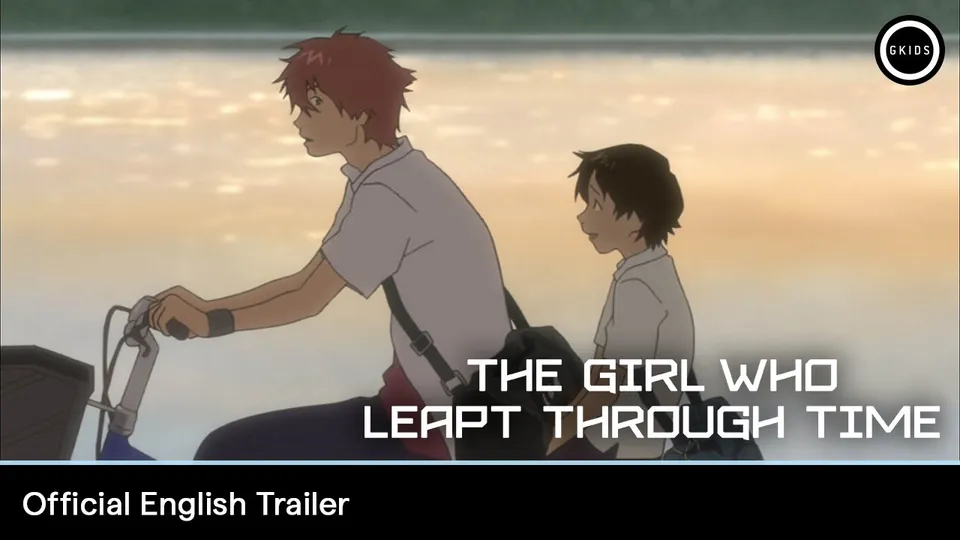
The premise
Seventeen-year-old Makoto Konno (Riisa Naka; Emily Hirst in the Ocean English dub) is a Tokyo high-school student who hasn't figured out her future. After an encounter with a mysterious walnut-shaped object, she discovers she can leap backward through time. She starts using it the way any teenager would: dodge lateness, patch grades, stretch a karaoke session for hours, undo an awkward confession. Then she learns that changing the past can hurt the people around her—and that her leaps aren't unlimited.
Her aunt, Kazuko Yoshiyama (Sachie Hara / Saffron Henderson), helps her make sense of what's happening. Friends Chiaki Mamiya (Takuya Ishida / Andrew Francis) and Kōsuke Tsuda (Mitsutaka Itakura / Alex Zahara) are easy summer company, until the leaps start making ordinary days feel less so.
How it handles time
The mechanism is almost domestic. Makoto falls onto a walnut-shaped device; the film later identifies it as a time-traveling object that belongs to someone else. Leaps go backward only. A numbered tattoo on her arm counts how many she has left, so every jump is a choice with a visible balance. That countdown is the film's best rule: no endless Groundhog Day reset, just a kid spending a finite stock of second chances.
Wikipedia's lead calls it a time loop where she repeatedly relives the same day. In practice it's voluntary reverse travel that can redo the same stretch of time. She leaps, lives it again, and learns that fixing her own awkwardness can shove trouble onto someone else. Loop-like, but not an involuntary daily prison—which is why the catalogue carries both time_travel and time_loop, with that nuance.
There's a second traveler in the mix, someone who can freeze time and who comes from the future for a reason tied to a painting being restored in Makoto's present. His identity belongs below the spoiler marker. Spoiler-free, the film stays inside one continuum—no parallel universes or labeled branch realities—and, by Wikidata's tag, leans toward a causal loop by the end. Interviews using bootstrap language weren't in the dossier, so I'm not putting that jargon in Hosoda's mouth. The tattoo, the backward direction, and the cost of each leap still hold.
What works
Hosoda and Satoko Okudera keep the sci-fi small so the summer can feel large. The early leaps are funny in a specific way: karaoke that stretches for hours, grades gamed, a confession dodged. You get why Makoto keeps jumping long before the film asks you to care that she should stop. When the cost lands, it lands because you watched her treat time like a cheat code.
Naka's Makoto (and Hirst in the English dub) sells the shift from breezy to cornered without speechifying. The friendship with Chiaki and Kōsuke feels like real high-school gravity: easy loyalty, clumsy romance, fear of saying the wrong thing. Yoshiyuki Sadamoto's designs and Madhouse's craft give the city a lived-in quiet. Nick Pinkerton in the Village Voice pointed to summer quietude and YA sensitivity; Ty Burr in the Boston Globe reached for a Studio Ghibli comparison; Anime News Network's Justin Sevakis called it "absolute magic." The movie earns that affection without needing a pile of adjectives stacked on top.
Kiyoshi Yoshida's score and Hanako Oku's "Garnet" and "Kawaranai Mono" keep the tone intimate when the plot bends. Awards followed the word of mouth: the Japan Academy Prize for Animation of the Year (2007), the Japan Media Arts Festival Animation Grand Prize (2006), Sitges Best Animated Film (2006), and Annecy's Special Distinction for Feature Film (2007). Tsutsui praised it as "a true second-generation" of his book at the Tokyo International Anime Fair on March 24, 2006.
What doesn't
The middle stretch of small fixes can feel episodic if you came for hard sci-fi architecture. Makoto leaps, patches a problem, leaps again. The pattern teaches the rules, but it postpones the sharper emotional turn until late. Anyone who wants lecture-board mechanics from minute 10 may get restless before the tattoo hits zero.
The romance also asks for a fairly large emotional jump once the second traveler's situation becomes clear. I buy it because the friendship work is already there, but the film spends more time on comic misuse of power than on building that attachment in plain sight.
Final score
Overall: 8/10. A warm, sharp anime about wasting second chances until you understand what they are for; an episodic middle and a late romantic turn are what keep it from a 9.
Paradox Meter: 4/5. Clear backward leaps, a visible use counter, and consequences that stick; the climax's causal-loop reading holds on a rewatch, with small gaps only if you press every edge.
If you liked this
Day Break

The Santa Clause 3: The Escape Clause

Donnie Darko
- The Girl Who Leapt Through Time (1983): the earlier live-action adaptation of Tsutsui's novel; different medium, same root. (not on the site yet)
- Time Traveller: The Girl Who Leapt Through Time (2010): later live-action with a different story; Riisa Naka returns as cousin Akari Yoshiyama. (not on the site yet)
- About Time (2013): reverse leaps that start as personal convenience and turn into what you owe other people. (not on the site yet)
Frequently asked questions
Is The Girl Who Leapt Through Time (2006) a time-travel movie?
Yes. Makoto gains the power to leap backward through time after an encounter with a walnut-shaped device, and she uses those leaps to redo everyday moments until she learns they aren't unlimited.
How does time travel work in The Girl Who Leapt Through Time (2006)?
Leaps go backward only. A numbered tattoo on Makoto's arm counts remaining uses, so each jump spends a finite stock of second chances. The film can redo the same stretch of time, but it isn't an involuntary same-day prison like Groundhog Day.
Is The Girl Who Leapt Through Time (2006) a time-loop movie?
Partly. Wikipedia's lead calls it a time loop where she relives the same day; this review reads it as voluntary reverse travel that can redo a stretch of time—loop-like, which is why the catalogue lists both time travel and time loop.
Is The Girl Who Leapt Through Time (2006) worth watching?
Yes, if you want time travel that starts with karaoke and late homework, then quietly turns the screws: it gets an 8/10 here. An episodic middle of small fixes and a late romantic turn are what keep it from a 9.
How consistent is the time logic in The Girl Who Leapt Through Time (2006)?
Solid. Paradox Meter: 4/5. Clear backward leaps, a visible use counter, and consequences that stick; the climax's causal-loop reading holds on a rewatch, with small gaps only if you press every edge.
Is The Girl Who Leapt Through Time (2006) based on a book?
Yes. It loosely adapts Yasutaka Tsutsui's 1967 novel of the same name, with a different story and characters. It is not the 1983 live-action film or the 2010 remake Time Traveller: The Girl Who Leapt Through Time.
Is "The Girl Who Leapt Through Dimensions" the same as The Girl Who Leapt Through Time (2006)?
No. "The Girl Who Leapt Through Dimensions" is a separate Korean-language AI web series on YouTube, started in 2026, about a girl jumping between dimensions, with no listed tie to Tsutsui's novel or to Hosoda's film. The 2006 anime stays in one timeline: Makoto leaps backward through time.
⚠ Spoilers: the timeline explainedShow spoilersHide spoilers
At Kuranose High School, Makoto finds the message "Time waits for no one" on a blackboard and falls onto the walnut-shaped object. Riding to meet Kazuko at the Tokyo National Museum, her bicycle brakes fail at a railroad crossing and a train hits her—then she's back to just before the accident. Kazuko helps her understand she can "time-leap."
She burns leaps on grades, timing, karaoke, and dodging Chiaki's confession. The arm tattoo counts down. She tries to fix problems for everyone. When Chiaki phones to ask if she has been time-leaping, she spends her final leap to stop the call. Meanwhile Kōsuke and Kaho Fujitani borrow her faulty bike; with no leaps left, Makoto can't stop them from being hit by the train.
Chiaki freezes time. He's from the future; the walnut device is his. He leapt hoping to see a painting Kazuko is restoring, destroyed in his era. He stayed longer than planned because of Makoto, used his final leap to save Kōsuke and Kaho, and froze time only to explain that he can't return home—he broke the rules by revealing his origins and the device. Makoto realizes she loves him. When time resumes, he vanishes.
Chiaki's leap restored Makoto's final leap by returning to a moment before she used it. She leaps back to just after she first gained the power, so Chiaki still has one leap left. She recovers the spent device, tells him she knows everything, and vows to protect the painting so he can see it in his time. Before leaving, he says he will wait for her in the future. Makoto tells Kōsuke that Chiaki went to study abroad, and she has decided about her own future.
That is the causal loop in plain clothes: Chiaki's rescue spends his return ticket, restores hers, and her earlier leap preserves his last chance and the painting that justified the trip. The film prefers the human answer over the physics lecture: she stops treating time as a private undo button, and she chooses a future instead of leaping past it.
Spoiler questions
What happens at the end of The Girl Who Leapt Through Time (2006)?
Chiaki, from the future, freezes time to explain he can't go home after revealing the device; his leap restores Makoto's last use. She leaps earlier, protects the painting he came to see, and he says he will wait for her in the future.
Who is the second time traveler in The Girl Who Leapt Through Time (2006)?
Chiaki Mamiya. He is from the future; the walnut device is his. He came hoping to see a painting Makoto's aunt is restoring, stayed because of Makoto, and used his final leap to save Kōsuke and Kaho.
How does the causal loop work in The Girl Who Leapt Through Time (2006)?
Chiaki's rescue spends his return ticket and restores Makoto's final leap by returning to before she used it; her earlier leap then preserves his last chance and the painting that justified the trip. Wikidata tags the film with the characteristic causal loop.
Sources
Catalogue entry
Research dossier behind this review (14 sources)
- Wikipedia, "The Girl Who Leapt Through Time (2006 film)" (retrieved 5 Oct 2026)
- Wikidata, Q336012 "The Girl Who Leapt Through Time" (retrieved 5 Oct 2026)
- IMDb, "The Girl Who Leapt Through Time" (tt0808506) (retrieved 5 Oct 2026)
- TMDB, "The Girl Who Leapt Through Time (2006)" movie/14069 (retrieved 5 Oct 2026)
- British Board of Film Classification timing cited via Wikipedia reference for 98 minutes (BBFC page itself not re-fetched live; treat runtime as Wikipedia→BBFC chain) [1]
- Metacritic, "The Girl Who Leapt Through Time" (retrieved 5 Oct 2026)
- Rotten Tomatoes, "The Girl Who Leapt Through Time" (retrieved 5 Oct 2026)
- JustWatch US, "The Girl Who Leapt Through Time" (retrieved 5 Oct 2026)
- JustWatch UK, "The Girl Who Leapt Through Time" (retrieved 5 Oct 2026)
- JustWatch Italy, "La ragazza che saltava nel tempo" (retrieved 5 Oct 2026; page stamp 3 Oct 2026 18:00:56)
- Wikipedia / catalogue cross-check: The Girl Who Leapt Through Time (1983 film); Time Traveller: The Girl Who Leapt Through Time (2010) — see related slugs in database/titles.csv
- Funimation license note via Wikipedia citing Anime News Network, 18 Feb 2016 [1]
- Ken Iikura-Gross, "The Girl Who Leapt Through Time Film's Ticket Art Imagines What If She Did Go on That Date", Anime News Network, 4 Jun 2026 (retrieved 5 Oct 2026)
- Anime News Network press release, "Mamoru Hosoda's The Girl Who Leapt Through Time Coming to 4K UHD for the First Time", 1 Jul 2025 (retrieved 5 Oct 2026)
Poster and trailer
- Official poster: The Movie Database (TMDB)
- Official trailer: “THE GIRL WHO LEAPT THROUGH TIME 4K Remaster | Official English Trailer”, GKIDS Films on YouTube
Review by Loop & Branch Editorial. Published . Scores explained in How we review.