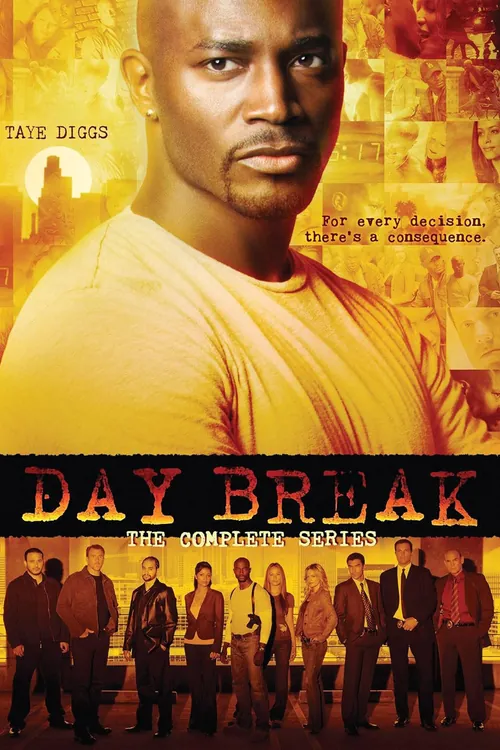
The premise
Detective Brett Hopper (Taye Diggs) of the LAPD is, in Wikipedia's words, "inexplicably repeating the same day, on which he is framed for the murder of the Assistant District Attorney, Alberto Garza." He has an alibi, but the evidence has been arranged against him. JustWatch's blurb puts the shape of each morning neatly: "He will offer his rock solid alibi. He will realize he's been framed. And he will run. Then, he will wake up and start the day over again."
The people around him matter from the start. Rita Shelten (Moon Bloodgood) is his girlfriend, a nurse. Andrea Battle (Victoria Pratt) is his partner, already under investigation by Internal Affairs. Jennifer Mathis (Meta Golding) is his sister, a teacher, and Damien Ortiz (Ramón Rodríguez) is his informant. Chad Shelten (Adam Baldwin) is his former partner, now in Internal Affairs, and also Rita's ex-husband, which makes every encounter between the two men tense before a word is said. Mitch Pileggi plays Detective Armen D. Spivak, and Jonathan Banks turns up as a figure called the "Shadow Man."
The goal, as Wikipedia describes it, is for Brett "to clear his name and uncover the truth."
How it handles time
The reset is precise, and the show leans on that precision. Every loop, Brett wakes at Rita's home "as the clock turns from 6:17 to 6:18 a.m." Each reset becomes a small dread machine: the same clock, the same bed, the same choice about what to try differently.
Two rules shape everything else. Brett "retains his memories, as well as any injuries," while everyone else has "no awareness or memory of the repeating day, nor do they retain injuries." The injury half of the first rule is the clever one. A bruise or a gunshot wound follows him into the next morning, so he can't treat a bad day as free practice, and the series gets real stakes out of a premise that could easily feel weightless.
The loop also punishes shortcuts. In Episode 2, running away has "disastrous consequences ... on others," and by Episode 6, "his actions turn out to affect the day in the worst possible ways," per the episode summaries on Wikipedia. Brett can't simply avoid the frame-up; the day keeps finding ways to make his escape someone else's problem. The conspiracy behind it, the summaries add, has "ties to those close to him," which turns each relationship into both a resource and a suspect.
What the show doesn't do, at least in the sources available, is say why the loop exists. Nothing consulted explains the cause, and I won't guess. In practice, the rules are the contract: memory and wounds carry over, nobody else remembers, the clock flips at 6:18. Day Break keeps to that contract closely enough that the mystery of the frame-up, not the mechanism, does the work.
Episode titles help, too. After the pilot, every one is a question that begins "What If," from "What If They Run" to the finale, "What If It's Him." It's a tidy way to frame each loop as a single experiment.
What works
Diggs carries the show. In a story built on repetition, he keeps Brett sympathetic even when the day turns him desperate. He also served as one of the producers, alongside Abe Hoch.
The structure is the other big asset. Because the day repeats, the writers can return to the same locations and conversations and make them play differently, and the supporting cast gets more texture than procedural partners usually do. Andrea's Internal Affairs trouble and Chad's double role as investigator and ex-husband give Brett problems that aren't solved by catching a killer.
Rob Bowman, also an executive producer, directed the pilot and five more episodes, including the finale. Paul Zbyszewski wrote or co-wrote five of the 13 scripts, and to me the episodes feel planned as a single arc, not as a cop show with a gimmick.
Most important, there is an ending. The story concludes in Episode 13, so anyone who starts Day Break today isn't signing up for a cliffhanger nobody resolved. Adam Baldwin made the case for watching it in one go in a 2021 interview: "It's not a linear show ... If it was on a Netflix-type format where you could just sit down and watch it chronologically, it would really hold up."
What doesn't
The release history works against the show to this day. ABC premiered it on November 15, 2006, and, according to Wikipedia citing ABCNews.com, canceled it "on December 15 after only six episodes had aired." The remaining seven episodes went online at ABC.com in early 2007, with the finale delayed to March 2 over music clearance issues, and reached television only in 2008 on TV One. Taye Diggs later blamed too few viewers and bad timing, while calling the script "one of the best scripts out there"; Moon Bloodgood's verdict was simply, "I think it's timing."
That history is also a practical problem for anyone who wants to watch now. As of November 12, 2026, JustWatch lists no way to stream, rent, or buy it in the US, and the UK has a single purchase option. The DVD set from 2008 is the most reliable route.
Within the show, the serialized design has a cost. Baldwin's point cuts both ways: a series this dependent on order is unforgiving if you miss an episode, and the conspiracy grows crowded with councilmen, detectives, and shadowy figures.
If you want a mechanism, the unexplained loop will bother you. The show treats the repetition as a given, which keeps the focus on the mystery but leaves the time logic thinner than the plotting around it.
Final score
Overall: 7/10. A smart, well-cast thriller with a complete arc, held back by a crowded conspiracy and a release history that made it hard to see.
Paradox Meter: 3/5. Clear, consistent rules about memory and injuries, used to raise the stakes, but no stated cause for the loop.
If you liked this

The Girl Who Leapt Through Time
Doctor Strange
- Source Code (2011): a US Army officer is sent into an eight-minute virtual re-creation of a real-life train explosion and tasked with identifying the bomber. (not on the site yet)
- Edge of Tomorrow (2014): in a future where aliens occupy most of Europe, a public relations officer with no combat experience is forced into a landing operation and finds himself in a time loop. (not on the site yet)
- Russian Doll (2019): a game developer repeatedly dies and relives the same night, and tries to work out why. (not on the site yet)
Frequently asked questions
Day Break (2006) explained: how does the time loop work?
Detective Brett Hopper wakes at his girlfriend Rita's home "as the clock turns from 6:17 to 6:18 a.m." on the same day, again and again. He keeps his memories and any injuries; everyone else has no memory of the repeating day. The sources never explain why the loop exists, and the Paradox Meter gives it 3/5.
Is there a Season 2 of Day Break (2006)?
The series ran for one season of 13 episodes, and the story concludes in Episode 13, "What If It's Him." ABC canceled it on December 15, 2006, after six episodes had aired; Episodes 7–13 premiered on ABC.com in early 2007 and reached television on TV One in 2008.
Why was Day Break (2006) canceled?
According to Wikipedia, citing ABCNews.com, ABC canceled it "on December 15 after only six episodes had aired." Taye Diggs later blamed too few viewers and bad timing while calling it "one of the best scripts out there"; Moon Bloodgood said, "I think it's timing."
Is Day Break (2006) worth watching?
For anyone willing to track it down, it is: it gets a 7/10 here. Taye Diggs anchors a tight 13-episode story with a real ending, and the loop rules raise the stakes. The conspiracy grows crowded, the loop is never explained, and the complete series is easiest to find on DVD (2008).
Who is in the cast of Day Break (2006)?
Taye Diggs plays Detective Brett Hopper. Moon Bloodgood plays his girlfriend, Rita Shelten; Victoria Pratt his partner, Andrea Battle; Meta Golding his sister, Jennifer Mathis; Ramón Rodríguez his informant, Damien Ortiz; and Adam Baldwin his former partner, Chad Shelten. Mitch Pileggi and Jonathan Banks also appear. Paul Zbyszewski created the series.
Sources
Catalogue entry
Research dossier behind this review (7 sources)
- Wikipedia, "Day Break", oldid 1379923381 (12 Oct 2026, 18:21 UTC = 20:21 CEST; raw wikitext retrieved 25 Oct 2026). (citations within: ABCNews.com 15 Dec 2006; E! News 19/20 Dec 2006; Playbill 7 Mar 2008; TV One 15 Apr 2008; Zap2It 14 Jan 2007; TV Series Finale 2 Mar 2007; TVShowsOnDVD 21 Jan 2008; Ratings Ryan; Shadow and Act; HitFix/Uproxx 16 Jun 2011; Will Harris Substack 24 Mar 2021; Premium Hollywood 2008)
- Wikidata, Q584745 "Day Break" (rev. 2538405325, 31 Aug 2026; retrieved 25 Oct 2026)
- JustWatch US, "Day Break" (GraphQL data for /us/tv-show/day-break; retrieved 25 Oct 2026, 13:52 CET)
- Rotten Tomatoes, "Day Break" (retrieved 25 Oct 2026)
- JustWatch UK / Italy, "Day Break" (GraphQL data for /uk/tv-series/day-break; IT none; retrieved 25 Oct 2026, 13:53 CET)
- IMDb tt0801425 (id only, via [1][2][3]; imdb.com not fetched)
- TV Series Finale, "Day Break: Taye Diggs Series Finally Comes to DVD" (BCI release announcement with packshot daybreak08a.jpg; retrieved 2 Nov 2026)
Poster and trailer
- Official poster: The Movie Database (TMDB)
Review by Loop & Branch Editorial. Published . Scores explained in How we review.