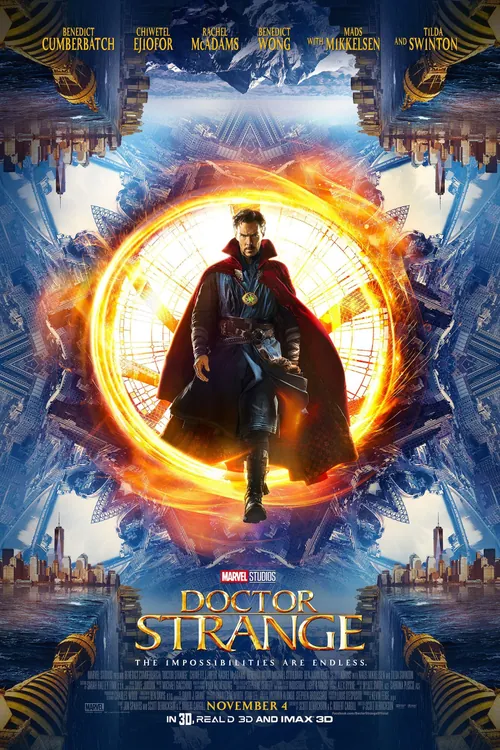
Trailer
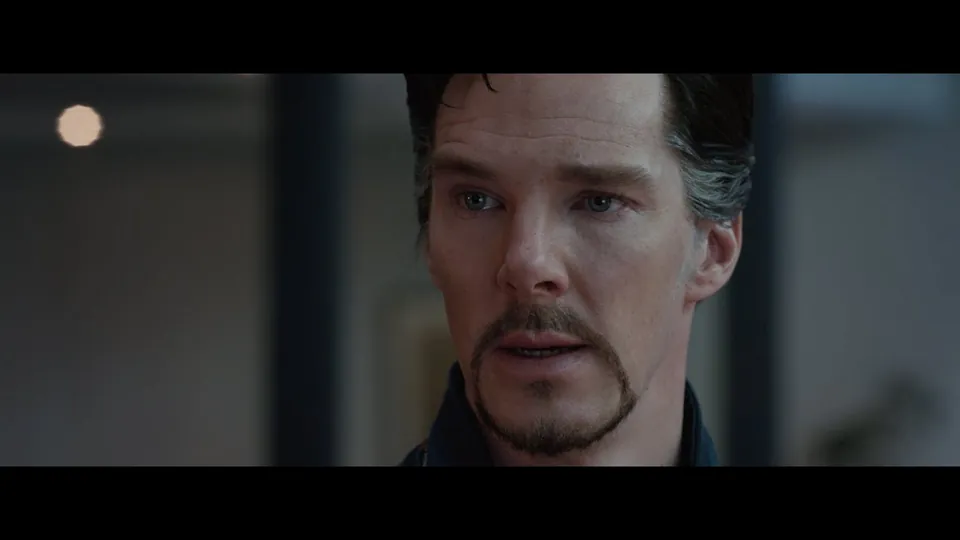
The premise
Dr. Stephen Strange (Benedict Cumberbatch) is a brilliant New York neurosurgeon, and he makes sure everyone knows it. Then a car crash wrecks his hands. Christine Palmer (Rachel McAdams), an emergency surgeon and his former lover, tries to help him move on, but he pours his fortune into experimental surgeries that fail. His last lead is Jonathan Pangborn (Benjamin Bratt), a paraplegic man who somehow walks again and points him to Kamar-Taj, a sorcerers' compound in Kathmandu.
There, Karl Mordo (Chiwetel Ejiofor) takes him in, and the Ancient One (Tilda Swinton), who has taught every student at Kamar-Taj, shows him the astral plane and a run of other dimensions before reluctantly agreeing to train him. Wong (Benedict Wong) keeps the library.
Trouble is already on its way. Before Strange ever arrives, Kaecilius (Mads Mikkelsen), a rogue former student, raids Kamar-Taj with his zealots, beheads the librarian, and steals pages from one of the Ancient One's books. He wants to open Earth to a destructive power from another dimension.
How it handles time
Most of the strangeness is about space. The Ancient One's demonstration sends Strange through seven dimensions. After that the film works with a few: the astral plane, where his spirit can leave his body, and the Mirror Dimension. Earth sits behind a shield generated by three Sanctums, in New York, London, and Hong Kong, a defensive map simple enough to sketch on a napkin.
This isn't a multiverse in the parallel-Earths sense. Kevin Feige said at the time it would not explore the comics' "Earth-616 and Earth-617" realities, so the other dimensions press against ours, but no alternate Earths show up. Feige called the character the "doorway" to the supernatural side of the MCU, and the 2022 sequel is the film that walks through it.
Time gets a single tool. Strange secretly reads the book Kaecilius stole from and learns to use the Eye of Agamotto, a relic that lets him "bend time." His first test is an apple in the library, which he runs backward. Nobody visits another era. The Eye works on whatever is in front of him, which is why the site files the film under time loops and parallel universes rather than time travel.
The rulebook is one sentence long. Mordo and Wong warn Strange that tampering with time breaks "the laws of nature," and that's it. The script never says what the Eye costs or how far it reaches, and Strange masters it so fast it feels like a key the plot can pull out whenever a door is locked. Does it keep its own rules? With so few of them, it barely gets the chance to break any.
The payoff comes at the end. Scott Derrickson has said he wanted the climax settled by an "intelligent use of power," as a jab at the MCU habit of a ruined city and "a portal that opens is closed just in time." How Strange uses time in the last act is the cleverest move in the film; the details are below the spoiler line.
What works
The Mirror Dimension chase is the reason to watch. ILM's "folding Manhattan" sequence runs to about 200 shots, and Derrickson said he wanted to take the effects of Inception (2010) "to the Nth degree and take it way more surreal and way farther." The filmmakers name Steve Ditko, M. C. Escher, and the game Monument Valley as influences, and that chase looks like all three at once. Its New York environment won a Visual Effects Society Award, and the film was nominated for the Oscar for Best Visual Effects.
Cumberbatch plays the early arrogance without asking you to like Strange, so the stretch of failed surgeries has a real sting. Swinton's Ancient One won her the Saturn Award for Best Supporting Actress, and her trip through the seven dimensions is where the film first shows its hand.
The film leans into its trippy side. Derrickson got Pink Floyd's "Interstellar Overdrive" onto the soundtrack alongside Michael Giacchino's score, and Stan Lee's cameo has him on a bus reading Aldous Huxley's The Doors of Perception, about as good a wink as those cameos ever got.
What doesn't
Under the effects is the standard origin: a proud man loses everything, finds a mentor, learns fast, and faces a villain who wants to let something terrible in. Mikkelsen gets a strong entrance in that early raid, but Kaecilius never grows past his plan.
Christine Palmer gets the thinnest deal. The film mostly uses her to tell Strange to let go and, later, to patch him up.
The casting of the Ancient One is the bigger problem. In the comics the character is a Tibetan man, and giving the part to Swinton drew accusations of whitewashing. The production also moved Kamar-Taj from Tibet to Nepal, which C. Robert Cargill said was to avoid censorship by the Chinese government. Swinton being good in the role doesn't settle the question. In May 2021 Feige said the decision had been a "wake-up call."
Final score
Overall: 7/10. The Mirror Dimension and the finale's idea earn the 7, and an off-the-shelf origin story with a one-note villain keeps it from going higher.
Paradox Meter: 3/5. The Eye of Agamotto has almost no stated limits, but the one big time trick the film builds toward is used cleanly and on purpose.
If you liked this
Avengers: Endgame
Dark
Spider-Man: No Way Home
- Doctor Strange in the Multiverse of Madness (2022): the 2022 sequel, directed by Sam Raimi, where the multiverse this film only hints at gets a full story. (not on the site yet)
- Spider-Man: Into the Spider-Verse (2018): another superhero film in the catalogue built on parallel universes, if the dimension-hopping was your favorite part. (not on the site yet)
Frequently asked questions
Is Doctor Strange (2016) a time-travel movie?
Not exactly. Strange learns to "bend time" with the Eye of Agamotto, starting with an apple he runs backward in the library, but nobody visits another era. The time rules are thin (Paradox Meter: 3/5, "Works if you don't push it"), and how he uses time in the last act is explained in the spoiler section.
Does Doctor Strange (2016) show parallel universes?
Other dimensions, yes; parallel Earths, no. The Ancient One sends Strange through seven dimensions, and the film uses the astral plane and the Mirror Dimension, but Kevin Feige said it would not explore the comics' "Earth-616 and Earth-617" realities. The full multiverse story comes in the 2022 sequel, Doctor Strange in the Multiverse of Madness.
Is Doctor Strange (2016) worth watching?
Yes, if you like Marvel movies best when they look least like Marvel movies: it gets a 7/10 here for the trips into other dimensions, above all the chase through a Manhattan that folds in on itself. An off-the-shelf origin story and a one-note villain keep it from going higher.
Which Doctor Strange movie is this review about?
The 2016 live-action film directed by Scott Derrickson, with Benedict Cumberbatch as Dr. Stephen Strange. It's the 14th film in the Marvel Cinematic Universe (Phase Three). It isn't the 2007 animated Doctor Strange, and its sequel is Doctor Strange in the Multiverse of Madness (2022), directed by Sam Raimi.
Is Doctor Strange (2016) like Inception?
In its effects, on purpose: Derrickson said he wanted to take the effects of Inception (2010) "to the Nth degree and take it way more surreal and way farther." ILM's "folding Manhattan" chase in the Mirror Dimension runs to about 200 shots, and its New York environment won a Visual Effects Society Award.
Why was the Ancient One's casting in Doctor Strange controversial?
In the comics the Ancient One is a Tibetan man, so casting Tilda Swinton drew accusations of whitewashing. The production also moved Kamar-Taj from Tibet to Nepal, which co-writer C. Robert Cargill said was to avoid censorship by the Chinese government. In May 2021 Kevin Feige said the decision had been a "wake-up call."
⚠ Spoilers: the timeline explainedShow spoilersHide spoilers
The Ancient One has a secret: she has been drawing power from the Dark Dimension to extend her life. Strange tells Mordo, and after a fight in New York's Mirror Dimension, Kaecilius mortally wounds her. Before she dies, she tells Strange that he and Mordo must work together.
By the time Strange reaches Hong Kong, the Sanctum has fallen, Wong is dead, and the Dark Dimension is swallowing Earth. Strange uses the Eye to run time backward and bring Wong back. This is Derrickson's answer to the portal-closed-in-time ending: a city gets un-destroyed before anyone goes through the portal.
Then comes the loop. Strange enters the Dark Dimension, the domain of Dormammu, "where time is non-existent," and wraps an endless time loop around himself and Dormammu. Dormammu kills him again and again, and every time the loop brings Strange back. Eventually Dormammu accepts a bargain: he leaves Earth forever, along with Kaecilius and the zealots, and Strange breaks the loop. Strange can't win the fight, so he makes himself the most boring opponent in the universe, and I love it.
How long it lasts is never stated on screen. Derrickson told Empire that an earlier script had Strange say "we've been through this a thousand times," and that he liked the idea of thousands of repeats, but the line isn't in the finished film. Cargill said in 2018, as reported by ComicBook.com, that they "left it intentionally vague," adding that "it wasn't just a few minutes." So I won't put a number on it either. The real gap is elsewhere: a loop needs time to repeat, and the film sets it in a place it describes as having none, without explaining how the Eye works there. I go along with it because the bargain is so clear, but that's what holds the meter at 3.
Mordo, disillusioned that Strange and the Ancient One both defied the laws of nature, walks away, which pays off his warning from the training scenes. Strange returns the Eye to Kamar-Taj, and it turns out to hold an Infinity Stone (Wikipedia's Infinity Stones article names it the Time Stone and marks this film as its debut). In the post-credits scene, Mordo takes Pangborn's power and declares that Earth has "too many sorcerers."
One last bit of trivia: Cumberbatch also played Dormammu, uncredited, as a motion-capture reference, his voice blended with another uncredited actor's. Derrickson said that choice implies Dormammu has no normal physical form and is imitating Strange.
Spoiler questions
How does Strange beat Dormammu in Doctor Strange (2016)?
He can't win the fight, so he traps Dormammu instead. In the Dark Dimension, "where time is non-existent," Strange wraps an endless time loop around them both. Dormammu kills him again and again, and the loop brings him back, until Dormammu agrees to leave Earth forever with Kaecilius and the zealots, and Strange breaks the loop.
How long was Doctor Strange in the time loop?
The film never says. Derrickson told Empire that an earlier script had Strange say "we've been through this a thousand times," but the line isn't in the finished film, and C. Robert Cargill said in 2018, as reported by ComicBook.com, that they "left it intentionally vague," adding that "it wasn't just a few minutes."
What happens at the end of Doctor Strange (2016)?
Mordo, disillusioned that Strange and the Ancient One both defied the laws of nature, walks away. Strange returns the Eye of Agamotto to Kamar-Taj, and it turns out to hold an Infinity Stone, which Wikipedia's Infinity Stones article names the Time Stone.
What happens in the Doctor Strange (2016) credits scenes?
In the mid-credits scene, Strange agrees to help Thor, who has brought his brother Loki to Earth, find their father, Odin. In the post-credits scene, Mordo takes Jonathan Pangborn's magical power and declares that Earth has "too many sorcerers."
Sources
Catalogue entry
Research dossier behind this review (12 sources)
- Wikipedia, "Doctor Strange (2016 film)" (revision of 26 Sep 2026; retrieved 29 Sep 2026)
- Box Office Mojo, "Doctor Strange (2016)" (retrieved 29 Sep 2026)
- The Numbers, "Doctor Strange (2016) – Financial Information" (retrieved 29 Sep 2026)
- Rotten Tomatoes, "Doctor Strange" (retrieved 29 Sep 2026)
- Metacritic, "Doctor Strange" (retrieved 29 Sep 2026)
- JustWatch US, "Doctor Strange" (2016) (retrieved 29 Sep 2026)
- JustWatch UK, "Doctor Strange" (2016) (retrieved 29 Sep 2026)
- JustWatch Italy, "Doctor Strange" (2016) (retrieved 29 Sep 2026)
- John Nugent, "Doctor Strange: 12 revelations from director Scott Derrickson", Empire, 7 Nov 2016 (retrieved 29 Sep 2026)
- "'Doctor Strange' Writer Shines New Light On Major Question From Film", ComicBook.com, 12 Apr 2018 (retrieved 29 Sep 2026)
- Wikipedia, "Infinity Stones" (revision of 28 Sep 2026; retrieved 29 Sep 2026)
- Tim Beyers, "Instant Analysis: For Disney Investors, 'Doctor Strange' Is Tracking Disappointment", The Motley Fool, 22 Oct 2016 (Wayback Machine copy of 24 Oct 2016; retrieved 29 Sep 2026)
Poster and trailer
- Official poster: The Movie Database (TMDB)
- Official trailer: “Doctor Strange Official Trailer 2”, Marvel Entertainment on YouTube
Review by Loop & Branch Editorial. Published . Scores explained in How we review.