Teaser
The premise
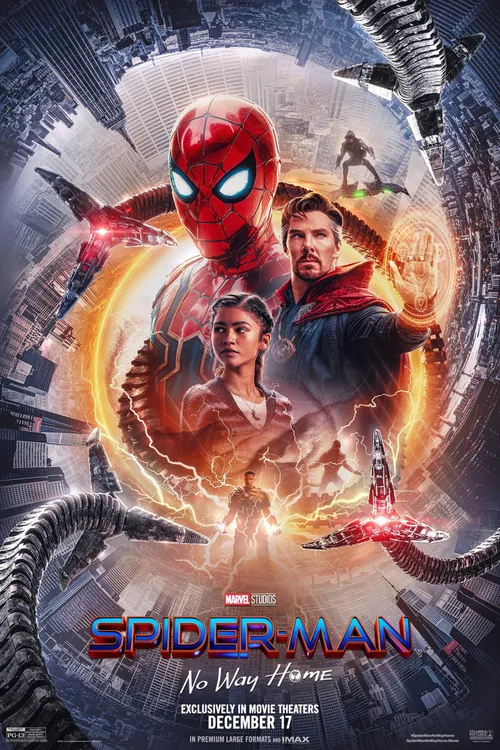
At the end of Far From Home, Peter Parker (Tom Holland) was framed for murder and unmasked as Spider-Man in front of the whole world. His life is upended, and so are the futures of his friends MJ (Zendaya) and Ned Leeds (Jacob Batalon).
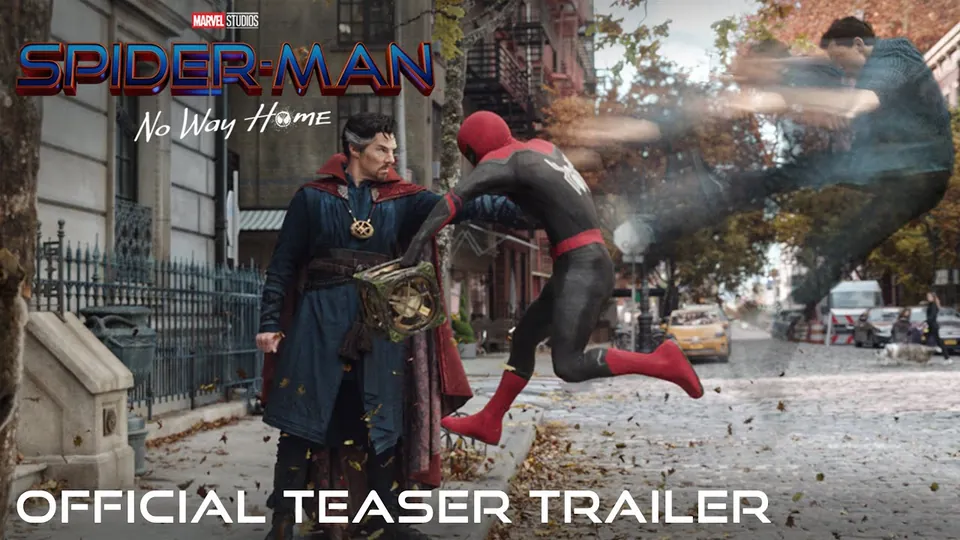
Peter goes to Dr. Stephen Strange (Benedict Cumberbatch) and asks for a spell that will make everyone forget he is Spider-Man. The spell goes wrong, the multiverse cracks open, and visitors from other realities start turning up in Peter's world.
How it handles time
Nobody travels through time here. The film's business is other universes, and it gets there through a wish. Wikipedia traces the story to an idea similar to It's a Wonderful Life (1946), with Peter making a wish about his public identity. That idea is what brought in Strange and the multiverse.
The mechanism is a spell with one weak point: Peter. He keeps asking for exceptions while Strange is casting it, and the changes corrupt it. Strange contains the spell, but by then people from other universes who know Spider-Man's secret identity have already been pulled in. On paper, that's a clear rule.
Everything past that rule is soft, and the writers admit it. Chris McKenna told TheWrap that the documents defining what the spell does, and what "the box" does, were still being written during production. For the forgetting, Erik Sommers said they considered a Back to the Future-style fade from photos, then dropped it because it raised too many questions, such as whether Peter would still have a driver's license. McKenna settled for "Obviously, some sort of magical redaction has occurred."
Strange also knows less than you'd expect. The film was first written to follow Doctor Strange in the Multiverse of Madness, and when the release order swapped, he lost his firsthand experience of the multiverse. McKenna told Variety that this "makes it even more frightening … because it's the fear of the unknown."
Why this spell crossed universes at all gets two answers. Marvel supplied one afterward, when Kevin Feige said that "Loki and Sylvie did something at the end of [Loki] that sort of allowed all of this to be possible." The writers didn't plan that. Sommers told TheWrap the story was already set when the Loki finale aired, though the finale "really helps" because "it shows that there's trouble in the Multiverse." Asked whether the timing lines up, McKenna said, "I don't know, I don't know."
What works
The film knows the difference between a crossover and a story. McKenna said it "wasn't going to be just curtain calls for everybody," and that it "told the story of this Peter Parker right now." I think that's why it still works once you know the surprises.
Holland holds it together. Richard Roeper of the Chicago Sun-Times wrote that "Holland remains the best of the cinematic Spider-Men," and he credited Zendaya with the "heart and smarts and warmth" she brings to every scene. Nicholas Barber at the BBC praised a screenplay that "interweaves teen-angst soap opera and cosmic calamity," which is a fair description of the first act.
Cumberbatch's Strange makes a good foil. In McKenna's words, he's "the voice of reason going, 'You don't mess with the fate of an individual.'" Michael Giacchino's score reworks his own Doctor Strange themes.
The audience reaction was enormous. It was the first live-action Spider-Man film to earn an A+ CinemaScore. It was also the highest-grossing film of 2021, and at the time the sixth-highest-grossing film ever. It won the Saturn Award for Best Superhero Film and was nominated for the Oscar for Best Visual Effects.
What doesn't
The plot only starts because Peter can't stop talking during a spell. Hannah Strong of Little White Lies found it "grating seeing the same character repeatedly fail to learn any lessons." I'm kinder than that, but I see her point in the first hour.
It's also proudly built out of earlier movies. Jake Cole of Slant called it "pure fan service, a greatest-hits mashup of Spider-Man's cinematic legacy." Robbie Collin of The Telegraph said it is what these films always are, "source material for its own advertising campaign," but "in this instance, it's little more." Richard Lawson of Vanity Fair felt the "brand Frankensteining" left "really no time for quirk and texture."
Not everyone felt the emotion, either. Bilge Ebiri of Vulture wrote that "even the film's more intimate moments fall flat." Benjamin Lee of The Guardian was more generous: "It's flawed for sure but still moves with more deftness than most."
Final score
Overall: 8/10. A crowd-pleaser that points its fan service at one Peter's growing up, held back by a careless setup and a lot of borrowed nostalgia.
Paradox Meter: 2/5. One clear rule (the spell pulls in whoever knows), surrounded by magic the writers kept vague on purpose and a cross-universe explanation Marvel supplied later.
If you liked this
Avengers: Endgame
Doctor Strange

Everything Everywhere All at Once
- Doctor Strange in the Multiverse of Madness (2022): the direct follow-on, which this film was first written to come after. (not on the site yet)
- It's a Wonderful Life (1946): the story grew from an idea similar to it, with Peter making a wish. (not on the site yet)
Frequently asked questions
Is Spider-Man: No Way Home a multiverse movie?
Yes. Peter Parker asks Dr. Stephen Strange for a spell that will make everyone forget he is Spider-Man; the spell goes wrong, the multiverse cracks open, and visitors from other realities start turning up in Peter's world. Nobody travels through time: the film's business is other universes.
How did the multiverse open in Spider-Man: No Way Home?
Through Strange's spell, which has one weak point: Peter. He keeps asking for exceptions while it's being cast, the changes corrupt it, and by the time Strange contains it, people from other universes who know Spider-Man's secret identity have already been pulled in. Beyond that, the rules stay vague. Paradox Meter: 2/5, "Loose."
Did Loki cause Spider-Man: No Way Home?
Not on screen. Kevin Feige later said "Loki and Sylvie did something at the end of [Loki] that sort of allowed all of this to be possible," but the writers didn't plan it: Erik Sommers said the story was already set when the finale aired, and Chris McKenna, asked about the timing, said, "I don't know, I don't know."
Should I watch No Way Home or Multiverse of Madness first?
No Way Home came out in December 2021, and Doctor Strange in the Multiverse of Madness in 2022. Kevin Feige said the botched spell "leads to the entire Multiverse going quite mad," and the original post-credits scene is a Multiverse of Madness teaser. The script was first written to follow Multiverse of Madness, but the release order swapped.
What should I watch before Spider-Man: No Way Home?
The two earlier Tom Holland films, Spider-Man: Homecoming (2017) and Spider-Man: Far From Home (2019). No Way Home starts right after Far From Home ends, with Peter framed for murder and unmasked as Spider-Man, and it leans on both films enough that this review says to watch them first.
Is Spider-Man: No Way Home worth watching?
Yes, especially after the two earlier Tom Holland films: it gets an 8/10 here. The surprises are a blast, but the ending earns the number, because it hits harder than anything else in Holland's three films. A careless setup and a lot of borrowed nostalgia hold it back.
⚠ Spoilers: the timeline explainedShow spoilersHide spoilers
The visitors are villains from earlier Spider-Man films: Otto Octavius (Alfred Molina), Norman Osborn (Willem Dafoe), Max Dillon (Jamie Foxx), Curt Connors (Rhys Ifans), and Flint Marko (Thomas Haden Church). They realize they were pulled from their universes "just before their deaths," which Wikipedia matches to the deaths in Spider-Man (2002), Spider-Man 2 (2004), and The Amazing Spider-Man 2 (2014). Strange wants to send them back. Peter refuses to send them to their deaths, traps Strange in the Mirror Dimension, and tries to cure them instead.
It costs him. Osborn's Goblin persona takes control again and fatally wounds May. Before she dies, she tells Peter that "with great power, there must also come great responsibility." Sommers said "there needed to be a loss, a sacrifice," so this would be "the movie where Peter Parker experiences the loss that the other ones did in their first movies."
Ned then opens portals with Strange's sling ring and finds two more Peter Parkers who were summoned too: "Peter-Two" (Tobey Maguire) and "Peter-Three" (Andrew Garfield). Holland said the film needed "all or none" of the returning actors. Ebiri, no fan of the film, still called Garfield a "genuine delight." At the Statue of Liberty, the three Peters cure Connors and Marko, and Octavius helps cure Dillon. Then the Goblin releases the contained spell, and the barriers between universes break. An enraged Peter-One tries to kill the Goblin. Peter-Two stops him, and Peter-Three helps Peter-One inject the cure that restores Osborn's sanity.
As more people who know his identity start to come through, Peter-One sees only one fix. He asks Strange to make everyone forget Peter Parker, and every visitor goes home. He promises MJ and Ned he'll find them again, but two weeks later he decides not to reintroduce himself. He makes a new suit and goes back to work as Spider-Man.
I think the logic of the ending is the film's best rule: the spell pulled in people who know Peter, so once nobody knows him, nothing holds them here. What the forgetting means in the other universes, no filmmaker source says. Spider-Man: Brand New Day (2026) treats it as permanent and starts from a world that has forgotten Parker. In the mid-credits scene, Eddie Brock (Tom Hardy) is sent back too, but he leaves a piece of the Venom symbiote behind, which is the kind of loose end that keeps the meter at 2.
Spoiler questions
Does Spider-Man: No Way Home have all three Spider-Men?
Yes. Ned opens portals with Strange's sling ring and finds two more Peter Parkers who were summoned too: "Peter-Two" (Tobey Maguire) and "Peter-Three" (Andrew Garfield). Their involvement was kept secret until release, and Holland said the film needed "all or none" of the returning actors. The three Peters team up at the Statue of Liberty.
Who are the villains in Spider-Man: No Way Home?
Five villains from earlier Spider-Man films: Otto Octavius (Alfred Molina), Norman Osborn (Willem Dafoe), Max Dillon (Jamie Foxx), Curt Connors (Rhys Ifans), and Flint Marko (Thomas Haden Church). They were pulled from their universes "just before their deaths," which Wikipedia matches to Spider-Man (2002), Spider-Man 2 (2004), and The Amazing Spider-Man 2 (2014).
Why did everyone forget Peter Parker in No Way Home?
Because Peter asks for it. When the Goblin releases the contained spell and more people who know his identity start coming through, Peter asks Strange to make everyone forget Peter Parker, and every visitor goes home. Two weeks later, he decides not to reintroduce himself to MJ and Ned.
What happens in the Spider-Man: No Way Home post-credits scene?
There are two scenes. In the mid-credits scene, Eddie Brock (Tom Hardy), brought to the MCU by Strange's first spell, is sent back too, but unknowingly leaves a piece of the Venom symbiote behind. The original release's post-credits scene is a teaser for Doctor Strange in the Multiverse of Madness; The More Fun Stuff Version has a new one instead.
Sources
Catalogue entry
Research dossier behind this review (21 sources)
- Wikipedia, "Spider-Man: No Way Home" (revision of 19 Sep 2026, 19:31 UTC, oldid 1375741680; retrieved 3 Oct 2026)
- Box Office Mojo, "Spider-Man: No Way Home (2021)", title summary, all releases (retrieved 3 Oct 2026)
- The Numbers, "Spider-Man: No Way Home (2021)" (retrieved 3 Oct 2026)
- Rotten Tomatoes, "Spider-Man: No Way Home" (retrieved 3 Oct 2026)
- Metacritic, "Spider-Man: No Way Home" (retrieved 3 Oct 2026)
- Metacritic, "Spider-Man: No Way Home" critic reviews, all/mixed/negative filters (retrieved 3 Oct 2026)
- Wikidata, Q68934496 "Spider-Man: No Way Home" (last revision 2552242111, 2 Oct 2026 17:44 UTC; retrieved 3 Oct 2026)
- BBFC, "Spider-Man: No Way Home" classification record (retrieved 3 Oct 2026)
- BBFC, "Spider-Man: No Way Home – More Fun Stuff" classification record (retrieved 3 Oct 2026)
- Marvel.com, "Marvel Studios' 'Avengers: Endgame' Returns to Theaters in September 2026" (published 25 Aug 2026 per page metadata; states "Avengers: Doomsday (in theaters December 18)"; retrieved 3 Oct 2026)
- Adam B. Vary, "'Spider-Man: No Way Home': Screenwriters Explain Surprises & Spoilers", Variety, 30 Dec 2021 (03:29 UTC per page metadata; retrieved 3 Oct 2026)
- Drew Taylor, "'Spider-Man: No Way Home' Screenwriters on Wrangling the Superhero Epic" (page title "Spider-Man: No Way Home Writers on That Ending, Andrew Garfield and More"), TheWrap, 8 Jan 2022 (retrieved 3 Oct 2026)
- Christine Dinh, "How 'Loki' Led Us to the 'Multiverse of Madness'", Marvel.com, 12 May 2022 (retrieved 3 Oct 2026)
- Ryan Scott, "Spider-Man: Across The Spider-Verse Is 'Not Tied Into The MCU' Despite That No Way Home Reference", /Film, 12 May 2023 (citing SFX Magazine; retrieved 3 Oct 2026)
- Wikipedia, "94th Academy Awards" (revision of 20 Sep 2026, 19:15 UTC, oldid 1375898115; retrieved 3 Oct 2026)
- Wikipedia, "50th Anniversary Saturn Awards" (reached via "47th Saturn Awards"; revision of 29 Mar 2026, 21:49 UTC, oldid 1346089167; retrieved 3 Oct 2026)
- Wikipedia, "List of accolades received by Spider-Man: No Way Home" (revision of 25 May 2026, 00:13 UTC, oldid 1355967931; retrieved 3 Oct 2026)
- Wikipedia, "Spider-Man: Brand New Day" (revision of 2 Oct 2026, 14:33 UTC, oldid 1378026183; retrieved 3 Oct 2026)
- JustWatch US, "Spider-Man: No Way Home" (fetched 3 Oct 2026, 06:46 CEST)
- JustWatch UK, "Spider-Man: No Way Home" (fetched 3 Oct 2026, 06:46 CEST)
- JustWatch Italy, "Spider-Man: No Way Home" (fetched 3 Oct 2026, 06:46 CEST)
Poster and trailer
- Official poster: The Movie Database (TMDB)
- Official teaser: “SPIDER-MAN: NO WAY HOME - Official Teaser Trailer (HD)”, Sony Pictures Entertainment on YouTube
Review by Loop & Branch Editorial. Published . Scores explained in How we review.