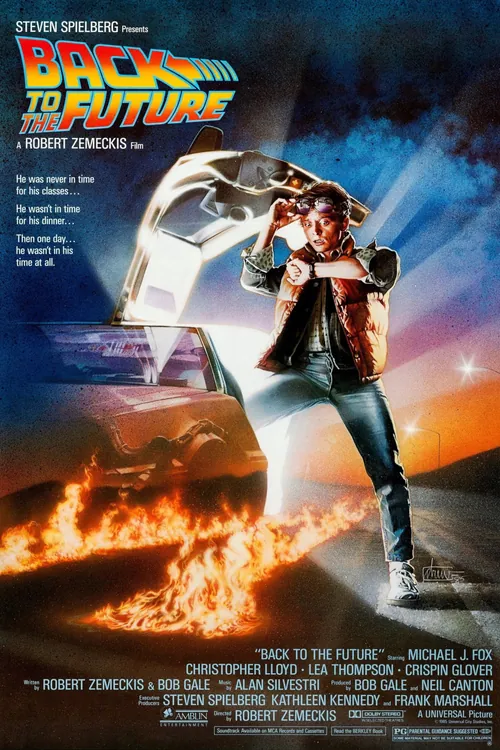
Trailer
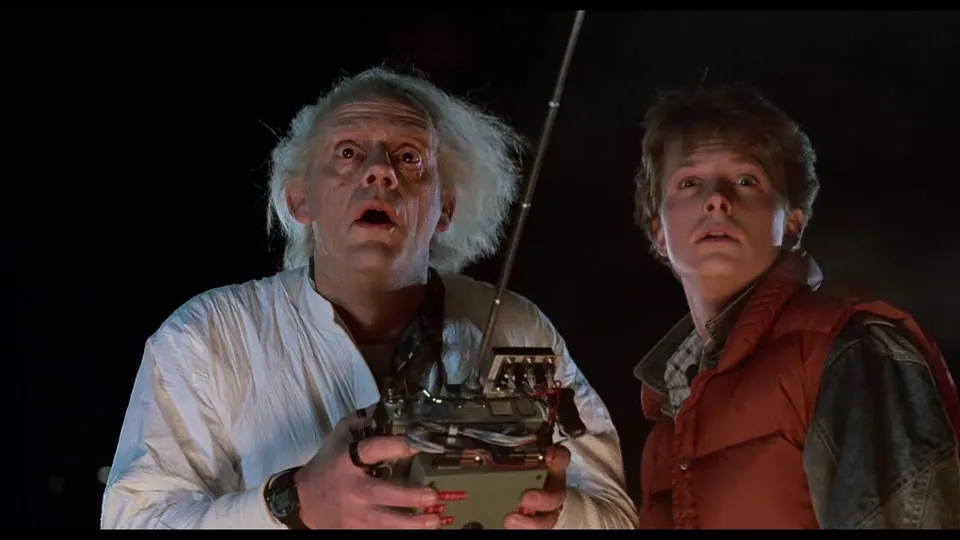
The premise
It's 1985 in Hill Valley, California. Marty McFly (Michael J. Fox) is a teenager who plays guitar in a band and has a family he'd rather not turn into. His father, George (Crispin Glover), is timid and gets bullied, and his mother, Lorraine (Lea Thompson), is unhappy. The adult Marty actually likes spending time with is Dr. Emmett "Doc" Brown (Christopher Lloyd), an eccentric scientist who has turned a DeLorean sports car into a time machine.
Doc's demonstration goes wrong, and Marty ends up alone in the car, 30 years back, in 1955. He meets his parents as teenagers and gets in the way of the moment they were supposed to fall in love. If they don't get together, he won't be born. So he has two jobs: play matchmaker for his own mom and dad, and talk the 1955 Doc Brown into helping him get the machine running again so he can go home.
How it handles time
The machine comes with a short list of rules, and the script teaches them to you like a user manual. The car has to hit 88 miles per hour. It needs 1.21 gigawatts of power, which the film pronounces "jigowatts" (the script spells it that way too). The flux capacitor, a Y-shaped box of flashing tubes, is what makes the jump possible, and Doc proves it works by sending his dog, Einstein, one minute into the future by remote control. In 1985 the power comes from plutonium Doc swindled from a group of Libyan terrorists. In 1955 there's no plutonium to be had, and finding 1.21 gigawatts some other way is what the whole back half of the film turns on.
That 88 was chosen to stick in your head: it was easy to remember and looked cool on the speedometer. The filmmakers even had to build a custom speedometer, because a 1979 US rule had capped them at 85 mph.
The bigger rule is the one Gale and Zemeckis set out to break. They felt many time-travel movies treated the past as fixed, so here it isn't: whatever Marty does in 1955 changes the 1985 he left. The film puts that on screen with a family photo Marty carries, which slowly changes as his future gets less likely. It's a simple, very visual ticking clock.
It also doesn't hold up if you poke it, and Gale is the first to say so. In a 2015 interview with The Hundreds, he called the photo "movie logic," asked out loud why the paper itself doesn't disintegrate, and said, "If you really think about this stuff, it makes absolutely no sense at all." In the FAQ on the official site, the writers answer other fan puzzles with several possible explanations, including a "self preservation" instinct in the space-time continuum. I don't mind any of it. The rules the film actually states (the speed, the power, a past you can change) never break. The ones it quietly bends are the ones it never explains.
What works
The script is the star. Zemeckis and Gale fill the 1985 scenes with details that matter once Marty lands in 1955. The time circuits show November 5, 1955, the day Doc slipped while hanging a clock, hit his head, and came up with the flux capacitor. James Tolkan plays Mr. Strickland, the school principal in both 1985 and 1955, a joke the film never stops to explain. Biff (Thomas F. Wilson) gets the same treatment: he's George's boss in 1985 and his bully in 1955, so by the time you meet the younger Biff, you already know how that story went the first time.
Christopher Lloyd's Doc is the performance everyone remembers. Kirk Ellis wrote in The Hollywood Reporter in 1985 that Lloyd "redefine[d] the mad scientist for modern movie audiences," and four decades later I still can't name a screen scientist who replaced him. Lea Thompson and Crispin Glover have the harder job, playing Marty's parents as teenagers and again 30 years later, and both versions feel like the same two people.
Fox is the glue, and the story behind his casting makes his ease even more impressive. Eric Stoltz was the original Marty and was let go weeks into filming. Fox took over in January 1985 and then shot Family Ties by day and this film by night until April.
The music carries a lot of the film too. Alan Silvestri's score is as recognizable as the DeLorean, and Huey Lewis and the News' "The Power of Love" went to No. 1 on the Billboard Hot 100. Huey Lewis also turns up, uncredited, as a Battle of the Bands judge.
What doesn't
The Libyan terrorists are the one part that has aged badly. They're there to explain the plutonium and to make the demonstration go wrong, and even in 1985 some reviewers found them in poor taste. Today they play as a lazy stereotype in a film that's otherwise careful with its details.
Not everyone was charmed at the time, either. Sheila Benson called it "big, cartoonish, and empty" in the Los Angeles Times. I disagree with "empty," but "cartoonish" fits Biff's gang: Skinhead, 3-D, and Match (a very young Billy Zane) are there to shove people, not to be characters. The ending has its critics as well, Crispin Glover among them. I get into that in the spoiler section below.
Final score
Overall: 10/10. It's the reference point for time-travel comedy, and I can't find a scene that doesn't earn its place.
Paradox Meter: 3/5. The rules it spells out hold firm, but the photo and who remembers what only work if you don't push too hard, and the writers say so themselves.
If you liked this
Donnie Darko
Loki
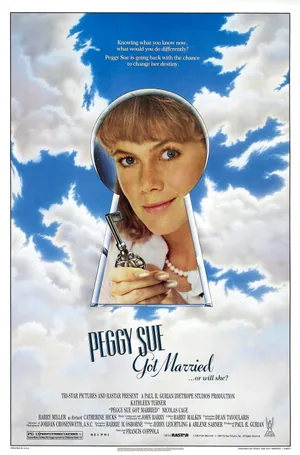
Peggy Sue Got Married
- Back to the Future Part II (1989): the direct sequel, shot back to back with Part III. (not on the site yet)
- Back to the Future Part III (1990): the one that closes the trilogy. (not on the site yet)
- The Time Machine (1960): the film nods to it, down to the colors on the DeLorean's time display. (not on the site yet)
- It's a Wonderful Life (1946): some 1985 critics made the comparison, since both follow a hero whose future changes. (not on the site yet)
- Time Bandits (1981): one of the time-travel flops studios pointed to when they turned this script down. (not on the site yet)
⚠ Spoilers: the timeline explainedShow spoilersHide spoilers
In 1955, Marty pushes the teenage George out of the path of a car and gets hit instead. Lorraine nurses Marty rather than George, which is how she was meant to meet her future husband, and she falls for her own son. From then on the photo starts to empty: first his brother and sister fade out, then Marty's own hand turns see-through.
The fix comes at the school dance. Marty's plan is to fake an unwelcome pass at Lorraine so George can "rescue" her, but Biff's gang locks Marty in a car trunk and Biff goes after Lorraine himself. George, who shows up expecting to find Marty, knocks Biff out. Marty takes over on guitar for an injured Marvin Berry, George and Lorraine kiss, and Marty is safe. Then he plays "Johnny B. Goode," and Marvin phones his cousin Chuck Berry so he can hear the "new sound." That's a bootstrap paradox (a loop in which something seems to have no origin) played as a joke. Screen Rant has argued it doesn't necessarily break the rules, because the riff borrows from Louis Jordan's 1946 "Ain't That Just Like a Woman (They'll Do It Every Time)." NPR raised a sharper point: the scene has a white teenager appearing to invent a genre heavily shaped by African-American music.
Lightning hits the courthouse clock tower at the exact time recorded on a flyer Marty brought with him from 1985, and the DeLorean jumps home. Marty sets it to arrive 10 minutes early so he can save Doc, but the car stalls and he reaches the mall just as Doc is shot. Then Doc sits up. He taped Marty's torn-up warning letter back together and wore a bulletproof vest. The 1955 Doc refused to read the letter because he feared the consequences, so this is Doc throwing out his own caution, and it's the happiest broken rule in the movie. The mall is now Lone Pine Mall, because Marty knocked down one of the two pines in 1955.
In the writers' model, Marty keeps his memory of the old 1985 because that's where he came from. So he wakes up to a family that has changed around him: George is a confident, successful science fiction author, Lorraine is fit and happy, and Biff is a servile valet working for George. Crispin Glover criticized this ending as materialistic, and in 2015 Zemeckis said he'd end it differently today (Gale disagreed). I see the point, since the new timeline is measured in money and status. What keeps it working for me is the cause. George's life changes because he stood up to Biff once, not because Marty brought him anything from the future.
In the last scene Doc reappears in the DeLorean, insisting that Marty and his girlfriend, Jennifer, come with him to the future to help their children. No sequel was planned at the time. The home-video release even added a "To Be Continued…" card, which was removed for the 2002 DVD.
Sources
Catalogue entry
Research dossier behind this review (22 sources)
- Wikipedia, "Back to the Future"
- AFI Catalog of Feature Films, "Back to the Future (1985)"
- Box Office Mojo, "Back to the Future (1985)"
- Oscars.org, "The 58th Academy Awards | 1986"
- Library of Congress, "Librarian of Congress Announces National Film Registry Selections for 2007" (27 Dec 2007)
- Library of Congress, Complete National Film Registry Listing
- Rotten Tomatoes, "Back to the Future"
- Metacritic, "Back to the Future"
- BBFC, "Back To The Future"
- Wikipedia, "DeLorean time machine"
- BacktotheFuture.com (official site), "The Most Frequently Asked Questions from Back to the Future" by Bob Gale & Robert Zemeckis
- The Hundreds, "An Interview with Back to the Future Co-Writer/Producer Bob Gale" (2015, around the film's 30th anniversary)
- Den of Geek, "Back to the Future Writer Steps in After 'Plot Hole' Debate Reopens" (Kirsten Howard, 23 Apr 2020; quotes Gale to The Hollywood Reporter)
- Screen Rant, "One Marty McFly Line Completely Breaks Back To The Future's Time Travel Rules" (Angel Shaw, 25 Oct 2024)
- American Film Institute, "AFI's 10 Top 10" (Sci-Fi list)
- Wikipedia, "Back to the Future Part II"
- Wikipedia, "Back to the Future Part III"
- Wikipedia, "Back to the Future: The Musical"
- Wikipedia (Italian), "Ritorno al futuro"
- JustWatch US
- JustWatch UK
- JustWatch Italy
Poster and trailer
- Official poster: The Movie Database (TMDB)
- Official trailer: “Back to the Future | 40th Anniversary Trailer”, Universal Pictures on YouTube
Review by Loop & Branch Editorial. Published . Scores explained in How we review.