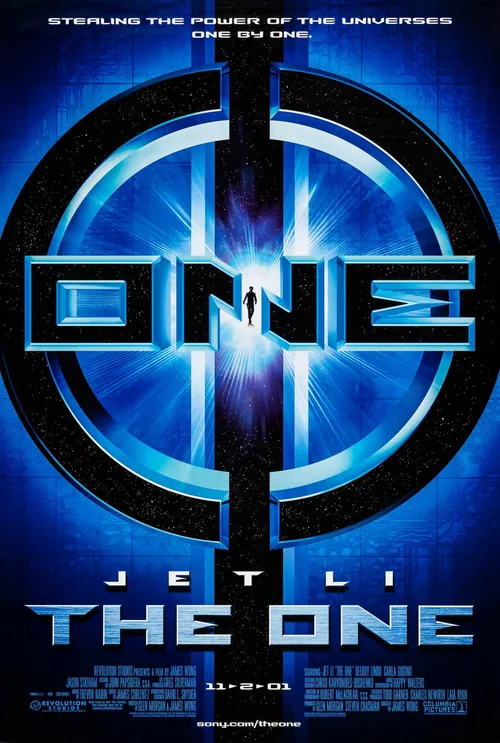
The premise
Gabriel Yulaw (Jet Li) is a rogue agent who, in Wikipedia's words, "travels to parallel realities in order to kill other versions of himself to become a mythical super-being known as 'The One.'" Every kill makes him stronger. The last version left standing is Gabe Law (also Jet Li), a Los Angeles County deputy sheriff with a wife, T.K. (Carla Gugino), who works as a vet.
On Yulaw's trail are two agents of the MVA, the MultiVerse Authority, as Wikipedia names the body that polices travel between universes. Harry Roedecker (Delroy Lindo) is Yulaw's former partner, and Evan Funsch (Jason Statham) is Roedecker's. Gabe, meanwhile, has to work out why a man with his face wants him dead.
How it handles time
There's no clock in this story at all; the travel runs between universes, never into the past or future. The multiverse is the classic kind. Robert Koehler of Variety summed it up: each human being "lives out separate but parallel lives in the various spheres." The film explains this in its opening minutes, and Koehler was unimpressed by "a leaden voiceover track and onscreen graphics."
How many universes are there? The sources don't agree. Roger Ebert's review assumes "there are 124 universes," and Koehler calls the number of Yulaw's other selves "equal, apparently, though never explained, to the number of universes in the entire system." Wikipedia instead counts the versions he hunts. What matters on screen is that Yulaw has worked his way through more than a hundred versions of himself, and Gabe is the last one left.
The central rule is the film's best idea. Ebert lays it out: "every time one of your other selves dies, his power is distributed among the survivors." So Yulaw gets faster and stronger with each kill. Wikipedia is careful to say Yulaw "believes" this will make him a godlike being; whether it would is left open. The opening narration raises the stakes further, warning, as Ebert quotes it, that "a force exists who seeks to destroy the balance so that he can become–The One!"
Travel itself is a policing problem. JoBlo's retrospective explains that people cross through "a random wormhole that opens up, but these wormholes can be tracked, just like the weather," and that the travel is "restricted and ... policed by a special group of law enforcement." Koehler mentions "James Bond-style gizmos," and that's as deep as the engineering goes.
The fights carry the theme better than the dialogue does. According to Li's book Beyond Life and Death and the DVD documentary Jet Li Is 'The One', as cited by Wikipedia, Yulaw fights in Xingyiquan, with "aggressive linear movements," and Gabe in Baguazhang, with "subtle, circular movements." Two versions of the same man, built from opposite styles: that's a smarter piece of world-building than anything the script says out loud. Ebert's own objection still stands, though. He asked why, if there are 124 universes, "would you want to kill off the other 123 versions of you?"
What works
Li is the whole show, and the dual role gives him something to play. Variety promised "a climactic battle between martial arts superstar Jet Li and … Jet Li, playing his good and bad selves," and the film delivers that, with Corey Yuen choreographing the action. It was Li's fourth English-language film, according to JoBlo, and the part was originally meant for Dwayne "The Rock" Johnson before Li took the lead, per Wikipedia.
The creative team knew genre television. James Wong and Glen Morgan had worked on The X-Files, and Koehler called them "vets of small-screen sci-fi." Lindo, JoBlo notes, had already worked with Li on Romeo Must Die. A few critics were won over. Loren King of the Chicago Tribune gave it three stars out of four, and Sean Axmaker of the Seattle Post-Intelligencer praised it as "a fun, inventive, mischievously tongue-in-cheek showcase" (both as quoted by Wikipedia).
It's also short. At 87 minutes, it doesn't overstay the welcome its premise earns. Wikipedia notes that some modern commentators now classify it as a cult classic within Li's Hollywood work, because of its martial arts scenes; JoBlo, by contrast, writes that it "doesn't have a notable following."
What doesn't
Most critics hated it, and their main complaint is mine. As of October 18, 2026, Rotten Tomatoes shows 13 percent from 89 reviews, with a consensus that it "plays more like a video game than a movie" and buries "Jet Li's spectacular talents under heaps of editing and special effects." Metacritic gives it 25 from 21 critics.
Ebert, who gave it 1.5 out of 4 stars, put it most simply: "The possibilities with this plot are endless. Alas, the movie is interested only in fight scenes." Koehler was harsher, writing that Wong and Morgan "waste all their resources on a singularly dumb and remarkably boring chopsocky storyline," and that the effects and Yuen's staging produce "something that's martial artless." I don't go that far on the action. I do agree the script never asks a single interesting question about what it means to meet yourself.
The money was middling too. Against a $49 million budget, it made about $44 million in the US and Canada and $72.7 million worldwide on its original release.
Final score
Overall: 4/10. Li's double act and two well-chosen fighting styles give it a few strong scenes, but a multiverse full of possibilities shrinks into a short chase picture.
Paradox Meter: 3/5. One clear rule (kill a version, share its power), tracked wormholes, and a count nobody explains; nothing contradicts itself, because the film barely tests its own ideas.
If you liked this

Frequently asked questions
Is The One (2001) a time-travel movie?
No. The One (2001) is a parallel-universe film: the travel runs between universes, never into the past or the future. A rogue agent crosses universes to kill other versions of himself, and Wikipedia files it under films about parallel universes, as does this site.
How does the multiverse work in The One (2001)?
Every person has versions in parallel universes, and, as Roger Ebert put it, "every time one of your other selves dies, his power is distributed among the survivors." Travel uses wormholes that, per JoBlo, "can be tracked, just like the weather," and the MVA polices the travel. The rules are simple and barely tested, so the Paradox Meter is 3/5.
Is The One (2001) worth watching?
Only for Jet Li fighting Jet Li: it gets a 4/10 here, because a premise with room for a dozen stories gets spent on a chase and a few brawls. Li's double act and two well-chosen fighting styles give it a few strong scenes, and at 87 minutes it doesn't overstay its welcome.
Who is in the cast of The One (2001)?
Jet Li plays both the villain, Gabriel Yulaw, and the hero, Gabe Law, a Los Angeles County deputy sheriff. Jason Statham and Delroy Lindo play Evan Funsch and Harry Roedecker, the MVA agents chasing Yulaw, and Carla Gugino plays Gabe's wife, T.K. According to Wikipedia, the film was originally meant to star Dwayne "The Rock" Johnson.
What fighting styles does Jet Li use in The One (2001)?
Two opposite ones. According to Li's book Beyond Life and Death and the DVD documentary Jet Li Is 'The One', as cited by Wikipedia, Yulaw fights in Xingyiquan, with "aggressive linear movements," and Gabe in Baguazhang, with "subtle, circular movements." Corey Yuen choreographed the action.
Why did critics dislike The One (2001)?
Mostly for wasting its premise. As of October 18, 2026, Rotten Tomatoes shows 13 percent from 89 reviews, and its consensus says the film "plays more like a video game than a movie." Roger Ebert wrote: "The possibilities with this plot are endless. Alas, the movie is interested only in fight scenes." Metacritic gives it 25.
⚠ Spoilers: the timeline explainedShow spoilersHide spoilers
The film opens with Yulaw killing Lawless, a violent criminal and Wikipedia's "123rd variant," in the Anubis universe. Roedecker and Funsch capture him and take him to the MVA's headquarters in the Alpha universe, Yulaw's home. He's sentenced to life in the Stygian penal colony of the Hades universe, escapes with an accomplice's help, and teleports to the Charis universe, where Gabe lives.
Gabe, the last known variant, has spent two years getting stronger, faster, and sharper without knowing why. He "feels" Yulaw's presence and dodges the first shot, and the agents stop Yulaw from finishing the job. At the hospital, the two identical men fight and both escape.
Then the film starts killing people. Roedecker fights Yulaw and dies, disabling the bomb he had meant to use on both of them. Funsch explains the multiverse to Gabe, including the wormholes that connect universes "at uncontrollable times." Yulaw tricks T.K. into hiding him, she realizes too late, and Gabe gets there only to watch Yulaw kill her. Gabe and Funsch team up.
The showdown is at an industrial plant. Gabe gets the upper hand just before a wormhole opens, and all three are pulled to the MVA headquarters. Yulaw tries to switch places with Gabe, fails, and is sent to the Hades universe. The MVA plans to send Gabe home to take the fall for Yulaw's crimes, but Funsch sends him somewhere else: a different universe "in which Gabe can have a normal life again from when he first met T.K." It's a jump sideways, not a trip back in time, and it's the film's one gentle idea. In the Hades universe, Yulaw declares he will still become the One and fights the inmates on top of a ziggurat. JoBlo identifies his line there and the Papa Roach song "Last Resort" on the soundtrack.
JoBlo also mentions small differences between universes, such as one where Los Angeles is the cleanest city in the US and another where Al Gore became president after the 2000 election. They're the closest the film comes to using the multiverse for anything other than a fight.
As logic, the plot is consistent because it never tests itself. The power-sharing rule explains Gabe's two years of growth. What the film never answers is Ebert's question: why become the One at all, and what would actually happen if he did.
Spoiler questions
What happens to Yulaw at the end of The One (2001)?
He doesn't become the One. At an industrial plant, Gabe gets the upper hand just before a wormhole pulls him, Yulaw, and Funsch to the MVA headquarters; Yulaw tries to switch places with Gabe, fails, and is sent to the Hades prison universe. He then vows he'll still become the One and fights the inmates on top of a ziggurat.
Where does Gabe end up at the end of The One (2001)?
In another universe, not in the past. The MVA plans to send Gabe home to take the fall for Yulaw's crimes, but Funsch sends him to a different universe "in which Gabe can have a normal life again from when he first met T.K.," as Wikipedia puts it.
Sources
Catalogue entry
Research dossier behind this review (15 sources)
- Wikipedia, "The One (2001 film)", oldid 1376945393 (27 Sep 2026, 02:41 UTC = 04:41 CEST; retrieved 18 Oct 2026; raw wikitext via the API)
- Wikidata, Q785098 "The One" (last revision 2537940725, 29 Aug 2026 23:15 UTC; retrieved 18 Oct 2026; P577 dates, P2047 runtime, P2130 budget, genres, IMDb tt0267804, TMDB 10796)
- Wikipedia (Italian), "The One (film 2001)", oldid 147862544 (14 Nov 2025, 16:28 UTC; retrieved 18 Oct 2026)
- Roger Ebert, "The One" (review), RogerEbert.com, 2 Nov 2001 (curl HTTP 403; read with WebFetch, 18 Oct 2026)
- Robert Koehler, "The One" (review), Variety, 22 Oct 2001 (page shows "Oct 22, 2001 5:11pm PT"; Wikipedia's citation says 23 Oct; read at source, 18 Oct 2026)
- Box Office Mojo, "The One (2001)" (tt0267804), summary and release groups (retrieved 18 Oct 2026, 10:48 CEST)
- The Numbers, "The One (2001)" (retrieved 18 Oct 2026, 10:48 CEST)
- Rotten Tomatoes, "The One" (page data; fetched 18 Oct 2026, 10:48 CEST)
- EJ Tangonan, "WTF Happened to The One?", JoBlo (last updated 30 Jan 2025; read with WebFetch, 18 Oct 2026)
- JustWatch US, "The One (2001)" (fetched 18 Oct 2026, 10:50:20 CEST; JustWatch ID tm706238) (— and for the URL trap justwatch.com/us/movie/the-one)
- JustWatch UK, "The One (2001)" (fetched 18 Oct 2026, 10:49:23 CEST; tm91623)
- JustWatch Italy, "The One (2001)" (fetched 18 Oct 2026, 10:49:23 CEST; tm320325)
- Metacritic, "The One" (fetched 18 Oct 2026, 10:48 CEST)
- TMDB, "The One (2001)", movie 10796 (page served in Italian: 1h 27m, release 23/08/2002 (IT), PG-13; retrieved 18 Oct 2026)
- Project note research/notes/tmdb-image-terms.md (Doc, 6 Oct 2026)
Poster and trailer
- Official poster: The Movie Database (TMDB)
Review by Loop & Branch Editorial. Published . Scores explained in How we review.