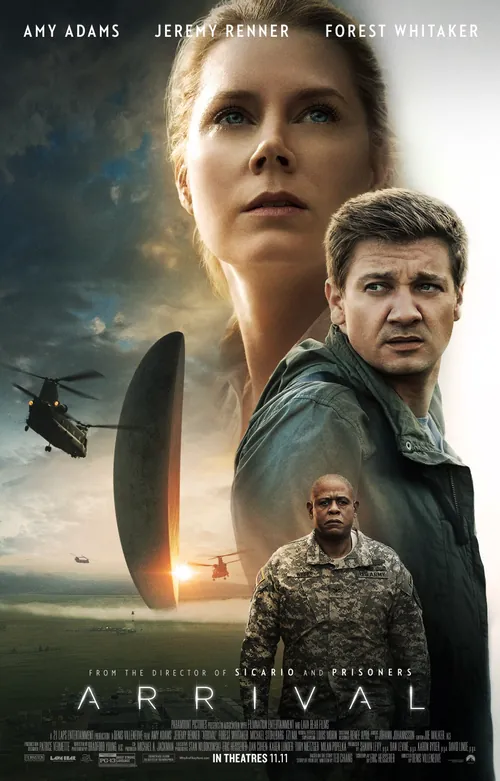
Trailer
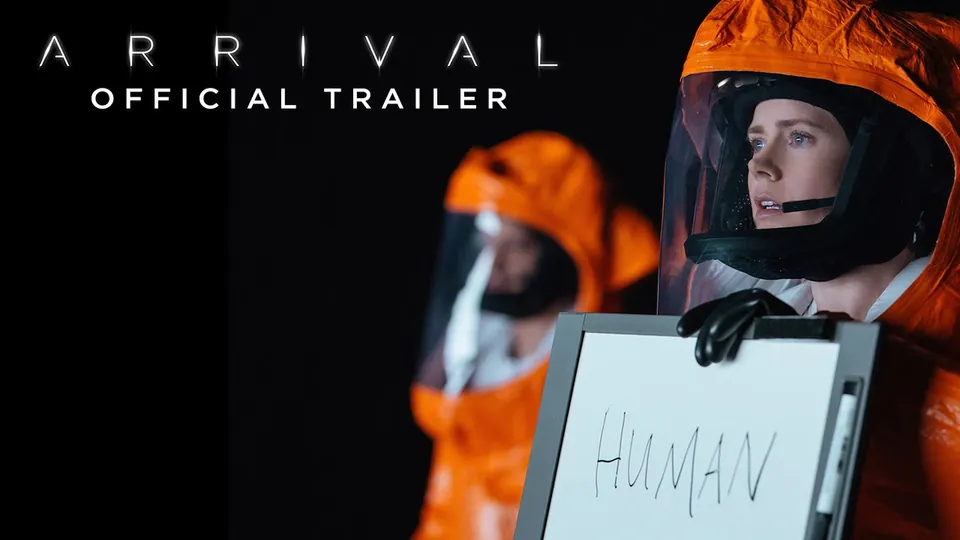
The premise
Twelve alien spacecraft appear over sites around the world. The US Army recruits Louise Banks (Amy Adams), a linguist, and Ian Donnelly (Jeremy Renner), a theoretical physicist, to go aboard the one hovering over Montana and find a way to talk to whatever is inside. Colonel Weber (Forest Whitaker) commands the US forces at the site, and Agent Halpern (Michael Stuhlbarg) is the CIA's liaison.
The occupants turn out to be seven-limbed creatures, the heptapods, and Ian nicknames the two they meet Abbott and Costello. Their written language is made of logograms, and Louise has to work out what the marks mean, and then why the visitors have come, while international tensions push the world toward conflict.
Before any of that, the film opens with Louise and her daughter, Hannah, and with Hannah's death from an incurable illness at 12. That sequence hangs over everything that follows.
How it handles time
There's no machine here, no portal, and nobody physically goes anywhere. The idea underneath is the Sapir–Whorf hypothesis, also called linguistic relativity: the notion that the language you speak shapes the way you think. Wikipedia's article on the novella traces Chiang's interest in it back to the Clarion workshop in 1989. Arrival asks what happens if the hypothesis is true and the language you're learning isn't human, and the film's time element grows straight out of that question. I'll leave it there, because how it grows is the twist.
Pay attention to the editing. In The New York Review of Books, James Gleick points out that the film uses the familiar screen shorthand for memory, "fragmentary images, representing memories," and he quotes Louise's voice-over: "Now I'm not so sure I believe in beginnings and endings." Villeneuve and his editor, Joe Walker, know exactly what you assume when you see those images, and they use that against you in the best way.
The rules are few and the film keeps them. Nothing resets, nothing branches, and nobody gets a second run at a bad day. There's one line of events, and the big payoff comes from following it to the end rather than from bending it. Gleick also calls the film "more explicitly time-travelish" than Chiang's story, and that's fair: Chiang's story has no version of the film's biggest time set piece, which I'll get to below the line.
Other changes from the page point the same way. In "Story of Your Life," contact happens through 112 "looking glasses" linked to ships in orbit; Heisserer had the aliens actually arrive, in 12 craft hanging over the planet, to give the film its tension. Chiang, who said he had "little involvement," thought the film came out better than he "had dared to hope."
What works
This is Adams's film. She won the National Board of Review's Best Actress award and was nominated for the Golden Globe, BAFTA, SAG, Critics' Choice, and AACTA awards, and Rotten Tomatoes' critics consensus singles out "a terrific performance from Amy Adams." I agree. Louise's progress is mostly a matter of marks being decoded, and Adams makes each small step forward feel like news.
The language looks real because people worked hard on it. The artist Martine Bertrand designed the logograms from Heisserer's concept, Stephen and Christopher Wolfram analyzed them, and three McGill University linguists consulted on the script, the sets, and the alien sounds. The linguist David Adger later called the film's picture of hypothesis testing "spot on." I love that a studio sci-fi film makes vocabulary a matter of life and death.
It sounds like nothing else, too. The film won the Oscar for Best Sound Editing, one of eight nominations, and Jóhann Jóhannsson's score earned Golden Globe and Grammy nominations. Max Richter's "On the Nature of Daylight" opens and closes the film, a choice that made the score ineligible for the Best Original Score Oscar, and I'd still make the same trade.
Bradford Young's photography and Patrice Vermette's design give the ships a plain, unsettling shape (the asteroid 15 Eunomia inspired it, and Vermette cited James Turrell's work). Most of it was shot in and around Montreal, with Saint-Fabien standing in for Montana.
What doesn't
The geopolitical subplot is the most ordinary thing in the film. Chiang said it "made total sense to add a geopolitical drama to make the story work as a movie, because the story is so internal," and he's right that the film needs a clock. But the scenes of rival governments and impatient officers play like a standard thriller next to the language work, and Weber and Halpern exist mostly to apply pressure.
Ian gets less to do than Renner deserves. Beyond nicknaming the heptapods and one key discovery I'll save for the spoiler section, the script gives the physicist little to play.
The science is a stretch. The linguist Betty Birner said the film's use of Sapir–Whorf went "beyond anything that is plausible." I don't mind, since the premise is the price of admission, but language nerds should know it going in. The pace may test some people as well: CinemaScore audiences gave it a B.
Final score
Overall: 9/10. Outstanding, with minor flaws: a first-contact film where the action is translation, and only the military subplot drags it toward the ordinary.
Paradox Meter: 4/5. One line of events, rules that never break, and a payoff that uses them, with a single chicken-and-egg question you only start chewing on during a rewatch.
If you liked this

Dark
Avengers: Endgame

The Girl Who Leapt Through Time
- Slaughterhouse-Five (1972): the film of Kurt Vonnegut's novel; Chiang has said Vonnegut's introduction to the book's 25th-anniversary edition sums up his novella's central theme. (not on the site yet)
- Interstellar (2014): Heisserer named it as the reason he and Villeneuve changed the ending of earlier drafts. (not on the site yet)
- Frequency (2000): in the catalogue for its radio link between 1999 and 1969, another time-travel story where nobody physically travels. (not on the site yet)
Frequently asked questions
Is Arrival a time-travel movie?
Not in the usual sense: there's no machine or portal, and nobody physically goes anywhere. How Arrival uses time is the film's central reveal, so the full answer is in the spoiler section at the bottom of this page.
Is Arrival worth watching?
Yes, if you want an alien-contact story built on patience instead of explosions: it gets a 9/10 here, mostly for Amy Adams as a linguist learning an alien language from nothing. Only the military subplot drags it toward the ordinary.
Does Arrival make sense?
Yes. The rules are few and the film keeps them: there's one line of events, nothing resets or branches, and nobody gets a second run at a bad day. Paradox Meter: 4/5, "Solid, with small gaps you only notice on a rewatch."
Is Arrival based on a book?
Yes. Eric Heisserer's screenplay is based on Ted Chiang's novella "Story of Your Life," first published in 1998, which won the 1999 Nebula Award for Best Novella. Chiang said he had "little involvement" in the film and that it came out better than he "had dared to hope."
How is Arrival different from "Story of Your Life"?
The aliens actually arrive: Heisserer swapped the novella's 112 "looking glasses," linked to ships in orbit, for 12 craft hanging over the planet, to give the film tension. The film also adds a geopolitical drama, which Chiang said "made total sense" because "the story is so internal."
What is the linguistic theory behind Arrival?
The Sapir–Whorf hypothesis, also called linguistic relativity: the idea that the language you speak shapes the way you think. The linguist Betty Birner said the film's use of it went "beyond anything that is plausible," while the linguist David Adger called its picture of hypothesis testing "spot on."
⚠ Spoilers: the timeline explainedShow spoilersHide spoilers
The scenes with Hannah aren't memories. As Louise learns the logograms, she has what Wikipedia's summary calls "flashback-like visions" of her daughter, and she finally realizes the girl hasn't been born yet. Learning the heptapods' language "alters humans' linear perception of time," and the opening was never the past.
The crisis runs alongside. Asked why they've come, the heptapods give an answer that can be read as "offer weapon." China reads it as "use weapon" and cuts off communication, other nations follow, and Louise argues the symbol can also mean "tool." Rogue soldiers plant a bomb in the Montana craft, and the heptapods push Louise and Ian out just before it goes off. General Shang (Tzi Ma) gives the ship over China 24 hours to leave. Ian then finds the symbol for time running through the latest message, which fills exactly one twelfth of its space, so the nations have to put their parts together. Costello tells Louise that Abbott is dying and that they're helping because in 3,000 years they'll need humanity's help. The "weapon" is the language.
Then the loop. In a vision of a future UN reception, Shang thanks Louise for calling his private number and repeating his wife's dying words, then shows her the number and whispers the words. In the present, she takes Halpern's satellite phone, calls him, and China stands down. Heisserer revealed that in English the words were "In war, there are no winners, only widows," and Villeneuve chose not to subtitle them. Gleick calls this a "science-fictional time loop" that isn't in Chiang's story: "The future is communicating with the past." Many fan sites call it a bootstrap paradox, information with no starting point, though I haven't found the filmmakers using the term. Shang knows the call happened because Louise made it, and she makes it because he told her. That's the chicken-and-egg question behind the 4.
The ending takes the same logic home. Louise knows she'll have a child with Ian, that Hannah will die, and that Ian will leave after she tells him she knew, and she says yes anyway. Nick Statt of The Verge reads that as free will "in the form of following through on a choice you already know you'll make." The philosopher A. G. Holdier calls the film's model of time one that "firmly denies the possibility of temporal editing." Chiang himself told HuffPost, "I certainly don't think there's a language that would enable us to see the future."
Spoiler questions
How does time work in Arrival?
Through Louise's mind. Learning the heptapods' language "alters humans' linear perception of time," in the words of Wikipedia's plot summary, so the scenes with Hannah are visions of a daughter who hasn't been born yet, not memories. Information from the future reaches the present, which is why the site counts Arrival as time travel.
Why do the aliens come to Earth in Arrival?
To help humanity, because in 3,000 years they'll need humanity's help in return, as Costello tells Louise. The "weapon" they offer is their language, which changes the way the learner perceives time, and each of the 12 craft holds one part of the message, so the nations have to cooperate.
What does Louise tell General Shang in Arrival?
His wife's dying words, in a call to his private number. Shang gives her both in a vision of the future; Heisserer revealed the words as "In war, there are no winners, only widows," which Villeneuve left unsubtitled. Fan sites call it a bootstrap paradox, though no filmmaker source uses the term; James Gleick calls it a "science-fictional time loop."
What happens at the end of Arrival?
China stands down after Louise's call, the other nations share their parts of the message, and the ships leave. Louise knows that she'll have a daughter with Ian, that Hannah will die at 12, and that Ian will leave after she tells him she knew. She says yes anyway.
Sources
Catalogue entry
Research dossier behind this review (15 sources)
- Wikipedia, "Arrival (film)" (revision of 13 Sep 2026; retrieved 29 Sep 2026)
- Box Office Mojo, "Arrival (2016)" (retrieved 29 Sep 2026)
- Wikipedia, "Story of Your Life" (revision of 3 Aug 2026; retrieved 29 Sep 2026)
- The Numbers, "Arrival (2016)" (retrieved 29 Sep 2026)
- Rotten Tomatoes, "Arrival" (retrieved 29 Sep 2026)
- Metacritic, "Arrival" (retrieved 29 Sep 2026)
- JustWatch UK, "Arrival" (retrieved 29 Sep 2026)
- JustWatch Italy, "Arrival" (retrieved 29 Sep 2026)
- Maddie Crum, "'Arrival' Author Thinks The Film's Written Alien Language 'Ought To Be Possible'", HuffPost, 14 Feb 2017 (retrieved 29 Sep 2026)
- Nick Statt, "How the short story that inspired Arrival helps us interpret the film's major twist", The Verge, 16 Nov 2016 (retrieved 29 Sep 2026)
- James Gleick, "When They Came from Another World", The New York Review of Books, 19 Jan 2017 issue (retrieved 29 Sep 2026)
- David Roark, "Alien and Time: The Philosophy of 'Arrival'", RogerEbert.com, 7 Dec 2016 (retrieved 29 Sep 2026)
- A. G. Holdier, "A Grammar in Two Dimensions: The Temporal Mechanics of Arrival and the Semantics/Pragmatics Divide", Journal of Science Fiction and Philosophy, published 4 Oct 2022 (retrieved 29 Sep 2026)
- JustWatch US, "Arrival" (retrieved 29 Sep 2026)
- Wikipedia, "Linguistic relativity", oldid 1380140619 (lead; retrieved 17 Oct 2026)
Poster and trailer
- Official poster: The Movie Database (TMDB)
- Official trailer: “Arrival Trailer (2016) - Paramount Pictures”, Paramount Pictures on YouTube
Review by Loop & Branch Editorial. Published . Scores explained in How we review.